Accountability — Trustee Conduct

The Trustee Who Used the Trust Against the Beneficiary

Abraham S. Horn, M.D. — sole trustee of the Jennifer Horn Family Trust of 1993 — used trust assets to keep the beneficiary in a hazardous, hostile building while refusing the relocation funds that would have let him leave. His stated reason for refusing: protecting his personal credit rating.

N.J.S.A. 2C:21-15 Trust Corpus: $350K–$390K Jennifer Horn Family Trust · 1993
§ 1

The Man Behind the Trust

Abraham S. Horn, M.D. ("Abe") is a retired gastroenterologist and former president of a multi-physician medical practice. He is the beneficiary Justin Horn's father. He is the sole acting trustee of the Jennifer Horn Family Trust of 1993 — a position that carries the full weight of fiduciary law.

His role creates a triple conflict: (1) Settlor — co-created the trust in 1993 with wife Pauline Horn, and has exercised amendment authority unilaterally; (2) Sole Acting Trustee — all disbursements, all vendor designations, all distributions flow through him exclusively; (3) Lease Guarantor — personal guarantor on the lease for Unit 806, 315 N. 12th Street, Philadelphia, PA 19107 (Goldtex Apartments).

The Core Conflict

The trust's original design called for no fewer than two trustees (Article SEVENTEENTH). Abe Horn simultaneously holds the roles of settlor, sole trustee, and lease guarantor — roles whose interests are irreconcilable in the present dispute.

§ 2

The Jennifer Horn Family Trust of 1993

Executed November 24, 1993, Camden County, New Jersey. Governing law: New Jersey Uniform Trust Code. Originally a supplemental needs trust for Jennifer Sherri Horn, a severely disabled daughter — designed to protect Jennifer while preserving Medicaid and SSI eligibility. Jennifer is now deceased. The trust holds remainder interests for Justin Horn and Alyssa R. Zentner (née Horn).

Current corpus: $350,000–$390,000 (per the trustee's own written description, May 21, 2025).

Date Action Effect on Justin Effect on Alyssa
Nov 24, 1993 Original trust Remainder beneficiary (equal share) Same
Jan 10, 2018 First Amendment "Sprinkle Trust" — capped at 10% of principal/year; ALL at trustee's sole discretion Mandatory quarterly income + $5,000 + 5% withdrawal power + uncapped HEMS
May 16, 2022 Second successor appointment REMOVED from successor trustee list Remains successor co-trustee
Mar 28, 2025 Second Amendment (Restatement) Cap REDUCED to 5%/year; trust renamed "Bloodline Trust"; disability provisions added All prior rights retained
Pattern

Each amendment moved in one direction: less cash access for Justin, more trustee discretion over Justin, and more structural leverage over Justin's disability classification. Alyssa's rights were never reduced.

§ 3

February 28, 2026 — The Line That Was Crossed

Rental License #602204 for Post Goldtex LP (315 N. 12th Street, Philadelphia) expired on February 28, 2026, and was not renewed. Under Frempong v. Richardson, 209 A.3d 1001 (Pa. Super. 2019), and Philadelphia Code §9-3902(1)(a), a landlord operating without a valid rental license is absolutely barred from collecting rent. The bar is not discretionary.

"A landlord who lacks a valid rental license is absolutely barred from collecting rent for the period of unlicensed operation."
Frempong v. Richardson, 209 A.3d 1001 (Pa. Super. 2019)

Every rent payment from trust assets after February 28, 2026 was paid to a payee that could not legally collect it.

Three post-expiration rent payments are documented: approximately $2,000 on March 1; approximately $2,000 on April 1; approximately $2,000 on May 1. The May 1 payment — made the same day a $10,000 relocation distribution was refused — is the trigger overt act for the criminal charge.

Philadelphia City Council passed the Safe Healthy Homes Act (Bill 250329) on April 23, 2026 (16-1 vote), creating an express rent-refund remedy during unlicensed operation.

§ 4

Three Written Notices. One Answer.

Before the trigger overt act on May 1, 2026, the trustee received three independent written notices that paying rent to an unlicensed landlord was unlawful.

April 9, 2026
Beneficiary's NJUTC Email — Justin Horn formally notified the trustee in writing, invoking the NJ Uniform Trust Code. He demanded cessation of rent payments to an unlicensed operator.
April 15, 2026
Constructive Notice — The Cordial Email — Greystar's Nicole Cordial sent the non-renewal notice to the trustee (not the tenant). The notice contains the forgiveness clause: "If he is able to relocate prior to the end of this 60-day period, we have agreed not to hold him responsible for any additional rent beyond his move-out date." The trustee's forward guarantor cash obligation was effectively zero after this date.
April 20, 2026
Attorney Letter — Justin's civil counsel, Joseph J. Console, Esq. (Console Matison LLP), sent the trustee a letter confirming the February 28, 2026 license expiration and its legal consequences, including the bar under Frempong.
April 28, 2026
Building-Wide Retaliatory Email — Greystar circulated a building-wide email that admitted the rental license "is in renewal" and referenced "outstanding items" — while excluding Justin Horn from the distribution. This is the document in which management acknowledged on the record that the license was not yet valid.
May 1, 2026
The Payment Anyway — The trustee paid May rent — approximately $2,000 from trust assets — and simultaneously refused a $10,000 relocation distribution request. Same day, Justin filed the 26-page Formal Notice to Trustee with 10 voluntary compliance demands.

The advice-of-counsel defense he offered on April 30 — "My attorney advised me to pay as guarantor" — collapsed within 48 hours. By May 2, he stated: "I told you that as guarantor I would continue to pay them." The attorney had vanished from the rationale.

§ 5

The Stated Motive

"Why should I jeopardize MY credit? For the 'privilege' of being your guarantor."
Abraham S. Horn, M.D. — iMessage, May 1, 2026

This is not a paraphrase. This is the trustee's stated reason — on May 1, 2026 — for refusing to fund a $10,000 relocation distribution that would have removed the beneficiary from a building with 16 open L&I violations, 2 Unfit Structure designations, documented toxic chemical exposure, and an active antisemitic assault case. Same day, the trustee paid May rent to keep the beneficiary's lease current. The credit line is not a claim that Horn was funding harassment. It is the admission that his own financial interest — his guarantor credit exposure — was the reason he chose not to fund the exit. Under N.J.S.A. 3B:31-55 (Duty of Loyalty), trust administration must be conducted solely in the beneficiary's interest. The protection of the trustee's personal credit rating is not the beneficiary's interest. It is the trustee's interest.

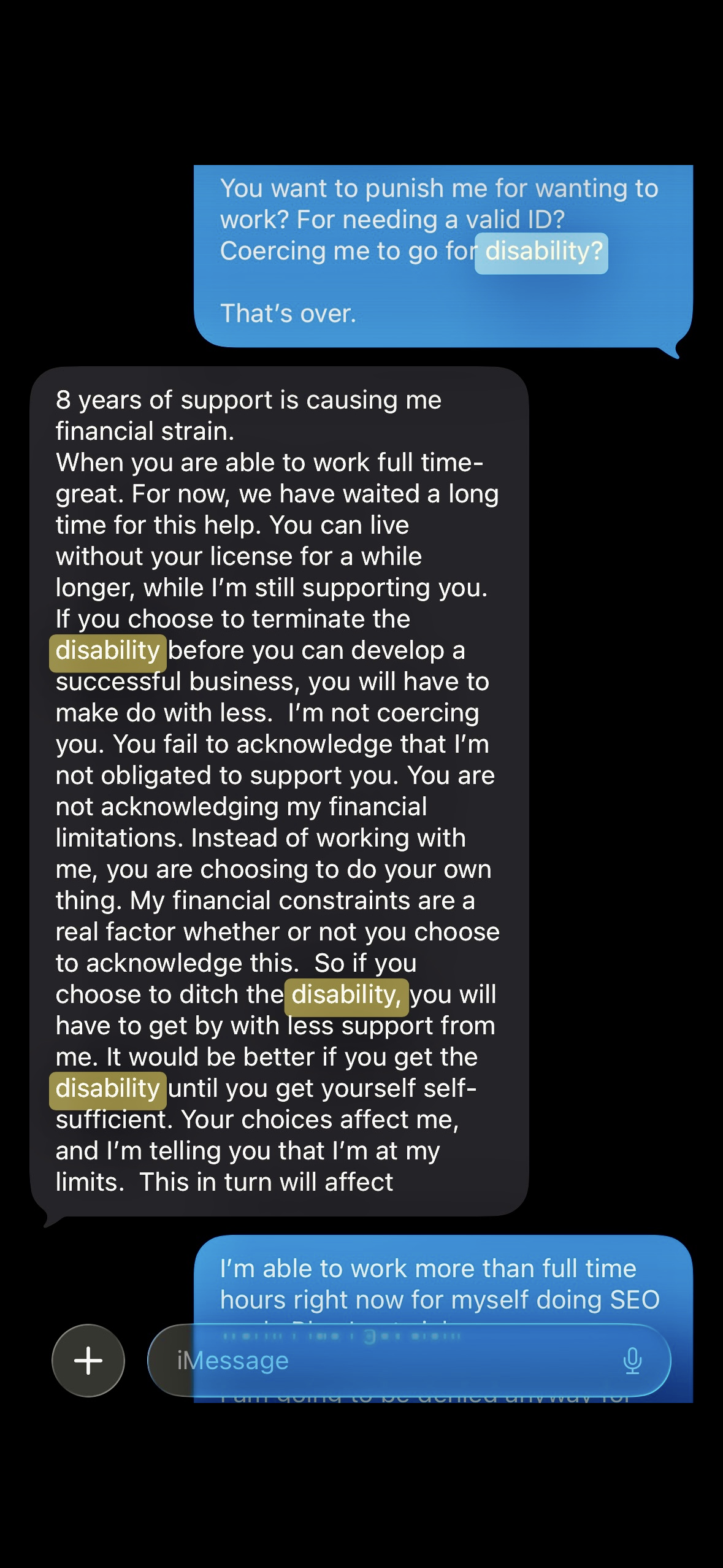
"I am helping you voluntarily because you have problems. It isn't mandatory."
Abraham S. Horn, M.D. — mischaracterizing mandatory fiduciary duties as voluntary charity
"You are not entitled to my support."
Abraham S. Horn, M.D. — mischaracterizing statutory rights under N.J.S.A. 3B:31-67
"Since the trust was created with elements of control..."
Abraham S. Horn, M.D. — May 4, 2026 — characterizing the trust as a control instrument
"I will be cutting back on all your supplemental monies for everything, since you are giving up the disability."
Abraham S. Horn, M.D. — December 31, 2025 — conditioning distributions on disability classification
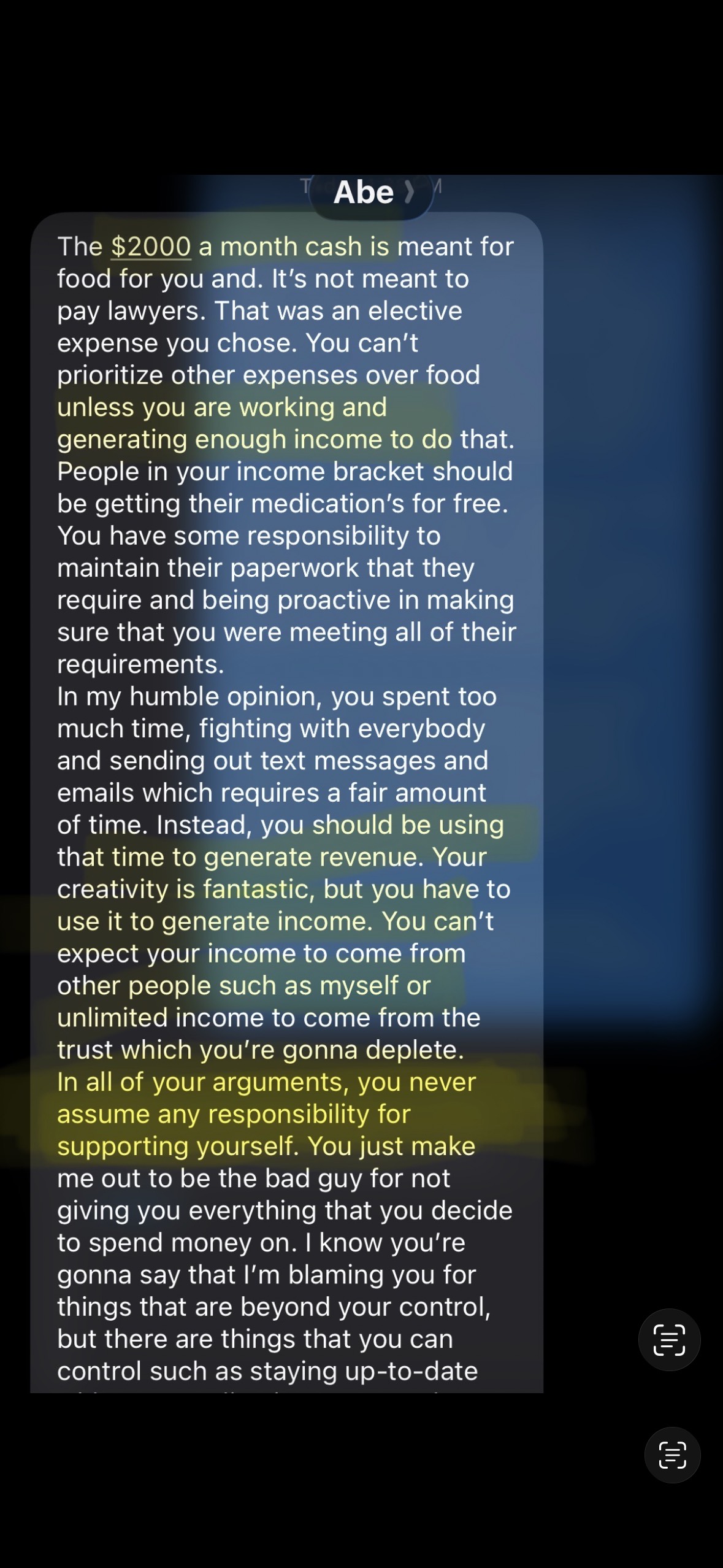
"Having to deal with YOU my entire life is the biggest problem of MY life … Nothing comes close to it."
Abraham S. Horn, M.D. — June 15, 2026
§ 6

How Trust Money Kept the Beneficiary Trapped

The claim here is not that the trustee funded harassment directly. Greystar and Post Brothers acted on their own. The claim is that the trust became the mechanism of entrapment: it paid rent that kept the beneficiary financially locked into a building he was trying to leave, while the trustee simultaneously refused the disbursement that would have let him leave.

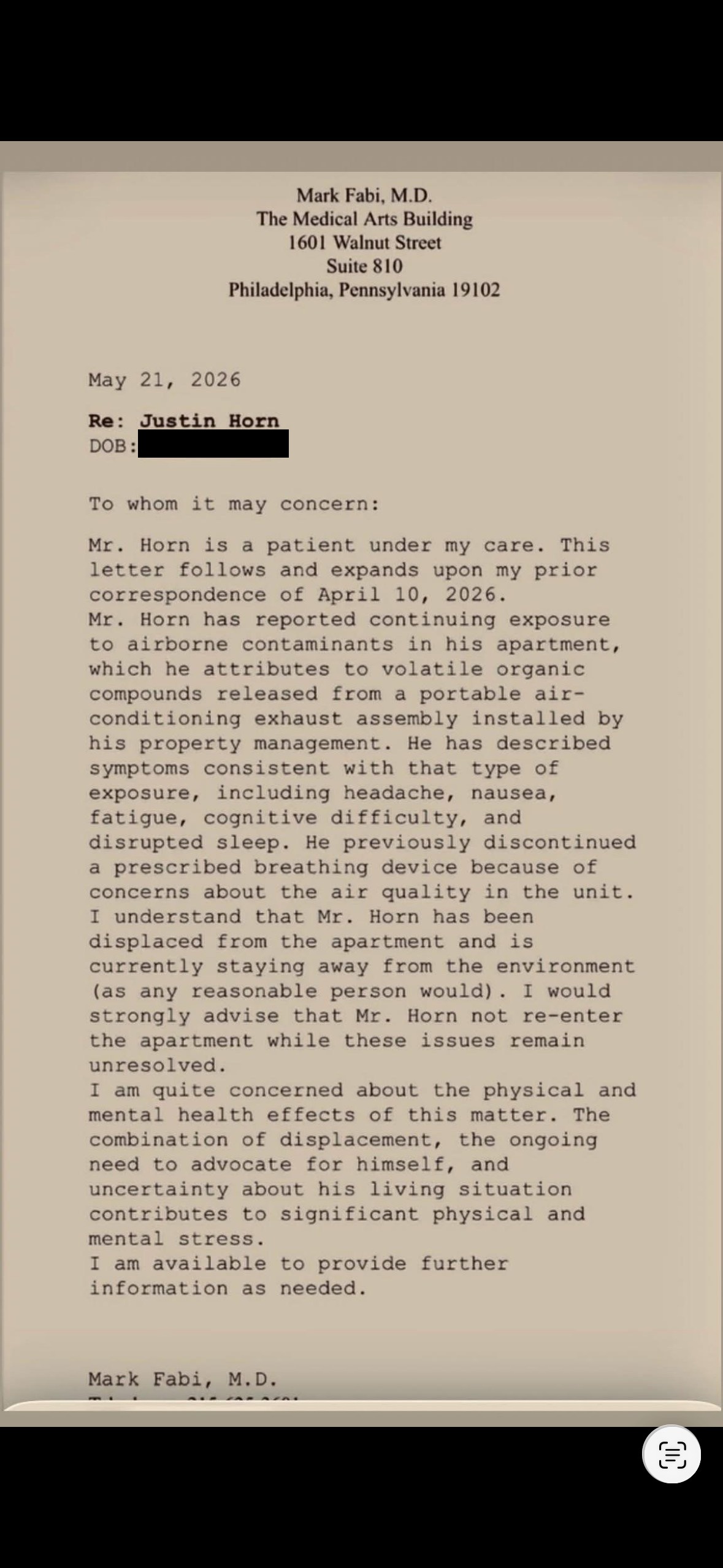
Trust assets paid rent to a landlord with 16 open L&I violations, 2 Unfit Structure designations, and 6 fire-safety violations — over the beneficiary's written objection, after three independent written notices that the payment was unlawful. Dr. Mark Fabi, M.D. confirmed airborne contaminant concerns in Unit 806 in a letter dated April 10, 2026. On May 6, 2026 — 5 days after the trigger rent payment — Justin was transported by ambulance to the ER.

The disability clause runs through all of this. The 2022 trust amendment added provisions that vest significantly expanded discretionary control in the trustee if Justin is determined to be disabled. The trust is the financial infrastructure that determines whether Justin has resources to fight back — and the trustee controls whether that determination is made.

The Entrapment Structure

Trust pays rent → beneficiary remains in hazardous building → relocation request submitted → trustee refuses (credit) → beneficiary cannot self-fund exit → situation escalates → trust disability clause becomes more relevant. Each refusal tightened the bind. The trust was not paying the harassers. It was paying the rent that made leaving impossible without the trustee's approval.

§ 7

What the Law Says

Charge Statute Degree Exposure
Misapplication of Entrusted Property N.J.S.A. 2C:21-15 Second Degree (>$75K cumulative) 5–10 years + up to $150,000 fine
Theft by Failure to Make Required Disposition N.J.S.A. 2C:20-9 Graded by amount
Theft by Deception N.J.S.A. 2C:20-4 Third Degree Up to 5 years + $15,000 fine
Criminal Coercion N.J.S.A. 2C:13-5 Fourth/Third Degree Up to 18 months + $10,000 (Fourth Degree); up to 5 years if elevated to Third Degree
Recklessly Endangering Another Person 18 Pa.C.S. §2705 Misdemeanor 2nd (PA) Up to 2 years + $5,000

The lead charge under N.J.S.A. 2C:21-15 is supported by State v. Coven, 408 N.J. Super. 482 (App. Div. 2009) (each payment is a separate completed offense) and State v. Cetnar, 341 N.J. Super. 257 (App. Div. 2001) (aggregation to $75,000 threshold supports second-degree treatment). State v. Mahoney, 188 N.J. 359 (2006): a professional who disregards known standards acts knowingly.

Primary civil remedy: Emergency trustee removal under N.J.S.A. 3B:31-48(b)(4) — standard is "best serves the interests of the beneficiaries"; no breach proof required.

§ 8

Ten Positions. No Coherent Narrative.

Between December 2024 and May 7, 2026, the trustee offered ten distinct, mutually contradictory positions on why he paid the rent. Under State v. Cofield, 127 N.J. 328 (1992), this pattern is admissible to prove knowledge, absence of mistake, and plan/preparation.

# Position Key Quote
1 Severable guaranty "Take me off as guarantor if you don't like what I do."
2 Voluntary trustee help "I will help you with the moving costs."
3 Advice of counsel "My attorney advised me to pay as guarantor."
4 Personal-credit self-interest "Why should I jeopardize my credit?"
5 Unaided guarantor reasoning "I told you that as guarantor I would continue to pay them."
6 Lease-condition reformulation "All you need is a lease, show it to me, and you're good to go."
7 Lawyer-to-lawyer routing "Tell your lawyer to reach out to my lawyer."
8 Attorney endorsement "My lawyer doesn't think anything I've done is wrong."
9 Trust-as-self equivalence "That's why it's a trust."
10 Bonafide-lease direct-pay "Give me a bonafide lease. Black out the landlord's name and address."
Documented Record

"This is not a dispute about family dynamics. It is a documented record of a trustee who used trust assets to fund the entity harming his beneficiary — and said so in writing."