This page documents three connected acts in late April 2026: factual flyers I posted about the building’s expired rental license, the removal and disposal of those flyers, and a building-wide email from management about “unauthorized flyers” that named me to every resident but was not sent to me.
The flyers, the photograph, and the email text below are documented. The accounts of who removed the flyers and what was said to me are my own first-person testimony, attributed as such. Where I draw a conclusion from those facts, I mark it as my inference. This is a documented personal narrative, not legal advice; I am not an attorney.
The flyers
Factual, signed, and protected.The notices were headed “PUBLIC TENANT ALERT — GOLDTEX HAS NO ACTIVE RENTAL LICENSE.” They stated a fact verifiable on the City’s own system: residential rental license #602204 expired February 28, 2026. They cited Philadelphia Code § 9-3901 et seq., pointed neighbors to free help (Community Legal Services, the Fair Housing Commission, and 311), named no individuals, and carried a plain disclaimer — not legal advice, not attorney advertising. They were signed simply: “posted by a Goldtex tenant engaged in lawful tenant organizing.”
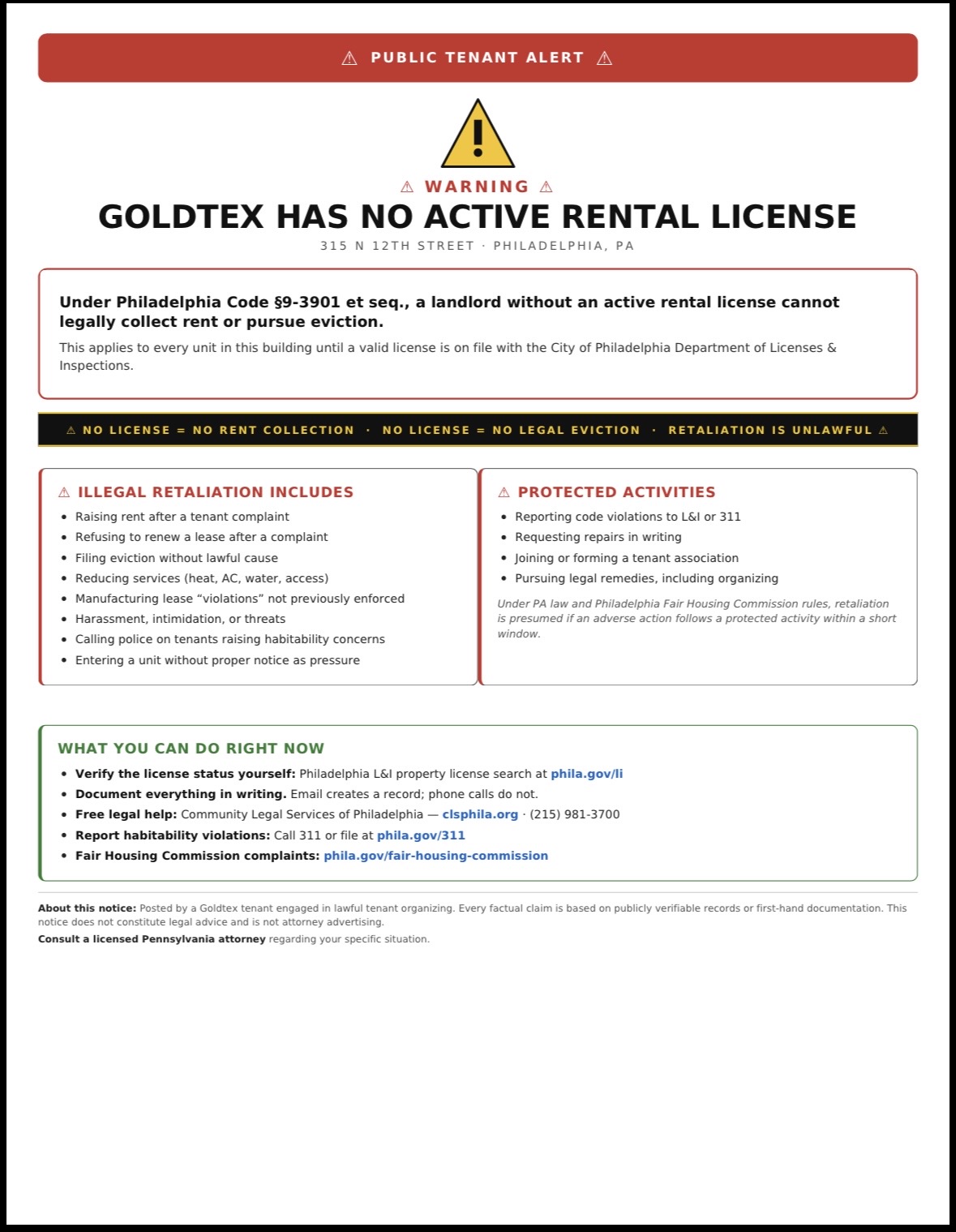
Each flyer carried its own footer, anticipating exactly what happened next:
The removal
Taken down. Thrown out. Called “unauthorized.”The flyers did not simply disappear. A resident named Eric Bridges told me directly that he had removed them. When I asked why, he said they were “unauthorized.”
Eric Bridges is the domestic partner of the building’s leasing manager, Nelson Alfonzo, and lived in the building. Separately, when I raised the expired rental license with Nelson Alfonzo, he told me:
In my reading of these facts, the removal was not the act of an unaffiliated neighbor who disliked a flyer. The person who removed them lived with, and is the partner of, the leasing manager — and the leasing manager’s own words treat the building’s compliance as something managed through a relationship with the city rather than through actual licensing. I read the removal as done on the building’s behalf. That connection is my inference; the statements above are what I was told.
Disposal, not preservation
If management believed the flyers were false or defamatory, the predictable response would be to preserve them — photograph them in place, keep a copy, attach them to an incident report, document the alleged misconduct. That is not what happened. The flyers were pulled down and thrown in the fitness-center trash. There was no documentation chain because none was being built. In my view, the act eliminated content rather than building a record — the behavior of someone making information disappear, not someone preserving evidence of a wrong.
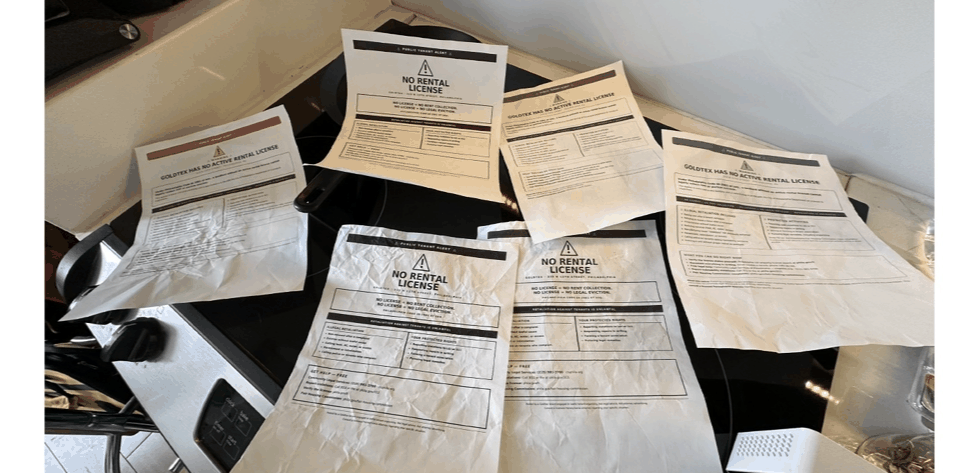
The fitness center is keyfob-accessed and camera-covered, and management posts its own promotional materials in the same locations. As the flyers’ own footer noted, the access logs and cameras document who enters those spaces.
The April 28 email
Subject: “Unauthorized Flyers.” Sent to everyone but me.On the afternoon of April 28, 2026, Greystar sent a building-wide email. I was not on the distribution. I learned of it, and obtained its text, from neighboring residents who received it. Reproduced verbatim:
Dear Residents,
We want to take a moment to address flyers that have recently been posted and distributed throughout the building. These materials are not being distributed by management or the City of Philadelphia.
The flyers are being circulated by an individual resident and do not reflect official communications regarding the property. For accurate information, please rely on direct communications from the management team.
We are actively working with the City of Philadelphia regarding our license renewal and are taking the necessary steps to address all outstanding items. We appreciate your patience and understanding as we continue to work through this process.
If you have any questions or concerns, please reach out to the management office directly.
Thank you,
Management Team
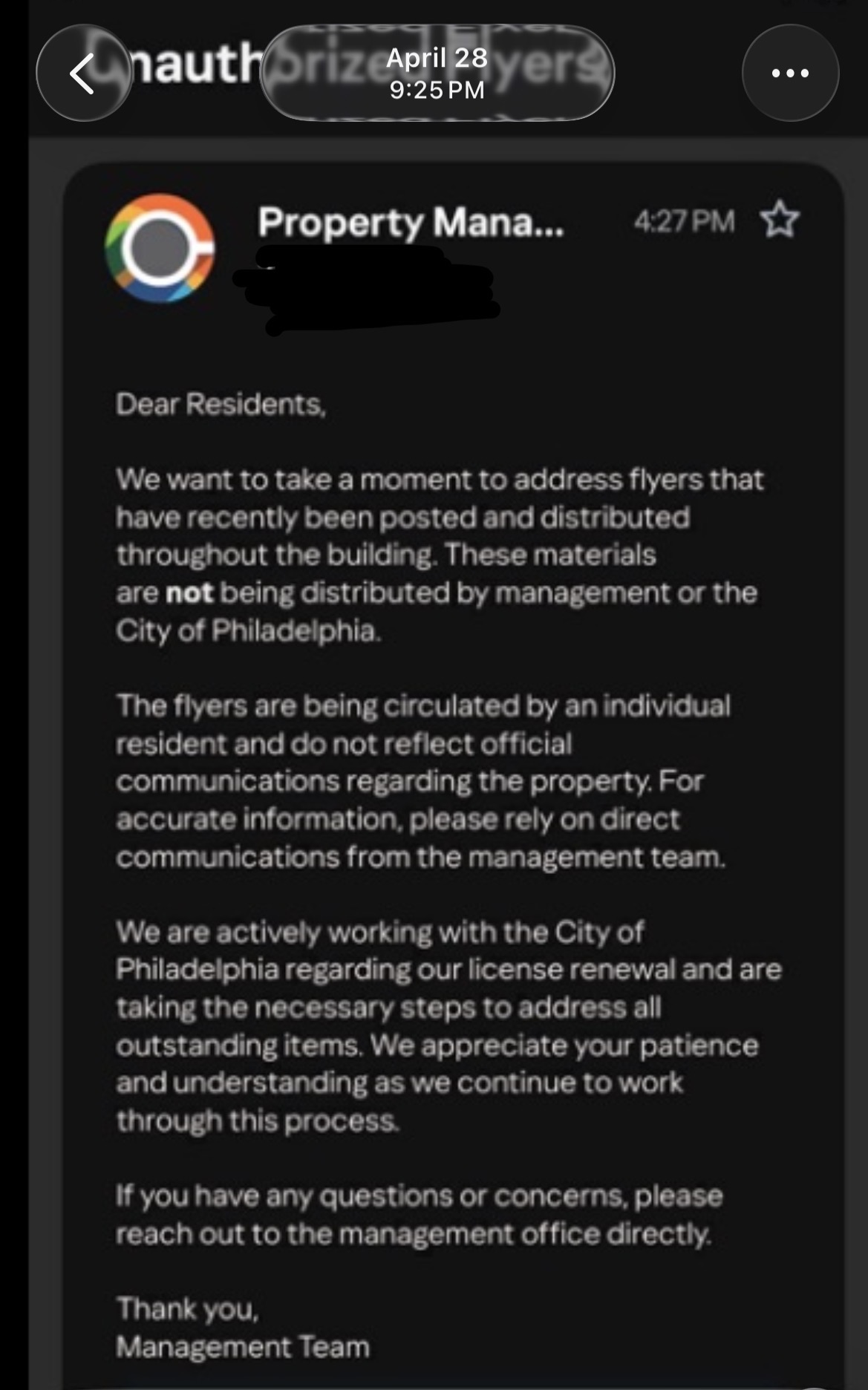
The email never identifies a single inaccuracy in the flyers, because the flyers were accurate. Four phrases carry the message:
- “license renewal”Concedes the license is not current — an active license is not a license being renewed.
- “outstanding items”Concedes items remain unresolved with the City of Philadelphia. The flyers said exactly this.
- “an individual resident”Refers to me to the whole building — without addressing me. I was the subject of the message and excluded from it.
- “for accurate information … the management team directly”Routes residents off the written record and into an in-person conversation at the office.
In my reading, two of those phrases are admissions and two are direction. The email does not correct the flyers. It concedes their core fact, then points residents toward a channel that leaves no record.
The same exclusion runs through three channels.
Looking at the conduct together, the same structure repeats: I am the subject of the communication and excluded from it.
Written
An April 15 email to my lease guarantor (my father) named me; the April 28 building-wide email named me to all residents. I was on neither distribution.
Physical
My notices to neighbors were taken down and thrown out — my message removed from being seen at all.
Verbal
Residents report being told, in person, that I “thinks we are trying to kill him, which is crazy” — a characterization delivered where it leaves no paper trail.
Each channel differs in mechanism. In my analysis they share one function: shape what my neighbors hear about me while keeping me unable to see or answer it.
Why the flyers were accurate
The single fact the flyers stated is confirmed by the City’s own record: residential rental license #602204 expired February 28, 2026 and was not renewed. The property manager, Greystar, holds no rental license at the address, and the L&I record shows open code violations outstanding at the parcel. The email’s own words — “license renewal,” “outstanding items” — concede the same thing the flyers said. (See The Convergence and Letter to Counsel for the license analysis.)
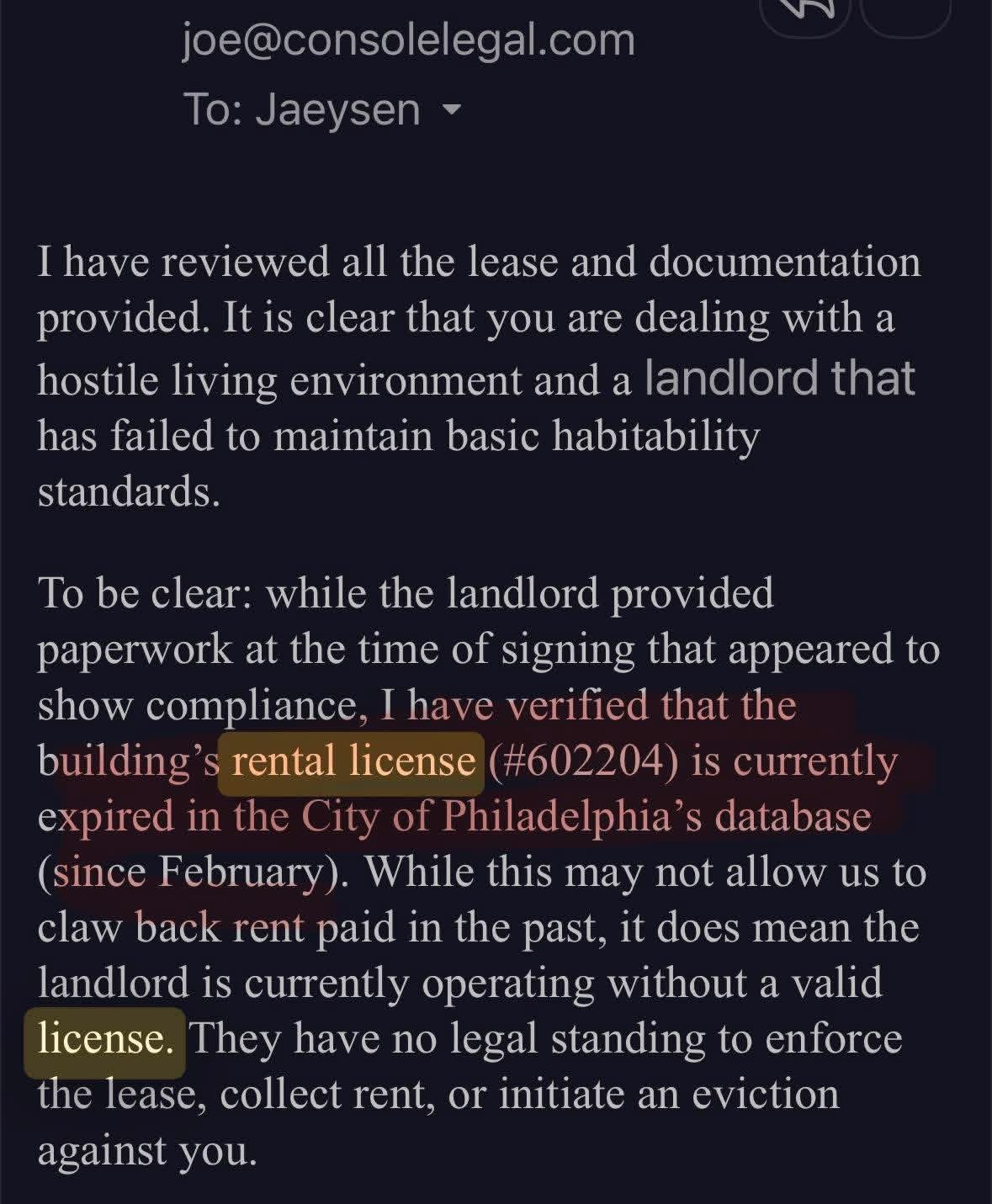
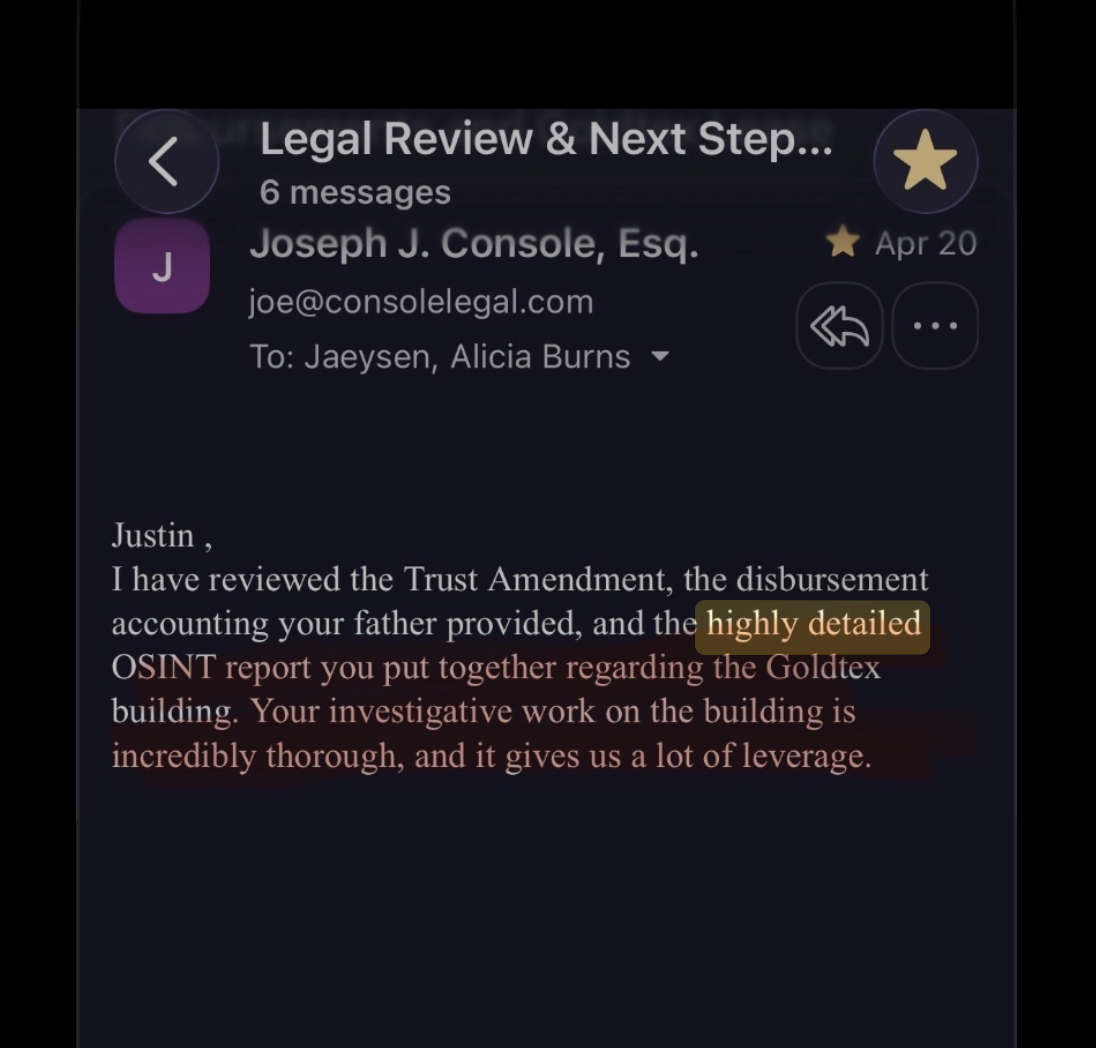
My own counsel independently confirmed the same fact. After reviewing the lease and documentation, attorney Joseph J. Console wrote that he had “verified that the building’s rental license (#602204) is currently expired … since February,” and that the landlord “has no legal standing to enforce the lease, collect rent, or initiate an eviction.”
What the law says
Public statutes, cited as the flyers cited them.I am not a lawyer, and nothing here is legal advice. These are the public provisions the notices themselves referenced:
- Philadelphia Code § 9-804Tenant organizing is treated as a protected activity; illegal lockouts and certain retaliatory acts are unfair rental practices enforceable through the Fair Housing Commission.
- Philadelphia Code § 9-1600Prohibits self-help eviction — landlords may not use removal, force, or interference in place of the lawful court process.
- Philadelphia Code § 9-3902Ties a landlord’s ability to collect rent and pursue eviction to holding a current rental license.
Anyone can confirm the license status independently at phila.gov/li. Removing a notice does not change the public record it points to.
New in 2026. On April 23, 2026, Philadelphia City Council approved the Safe Healthy Homes Act (sponsored by Councilmember Nicolas O’Rourke) by a 16–1 vote, effective November 1, 2026. Among its provisions, as reported: it codifies tenants’ right to organize and join a tenant association and bars landlords from changing lease terms or refusing to rent to tenants who reported violations or organized; it requires a landlord to hold an active rental license and a Certificate of Rental Suitability to collect rent, and lets tenants sue for rent collected without them; and it expands “good cause” eviction protection to all renters. The act is the subject of a pending legal challenge by landlord interests. It postdates the events on this page and is noted here as context, not as a claim about my own case.
Supporting documents
- The Email Is the Proof — structural analysis of the April 28 building-wide email (April 28, 2026)
- The Email Is the Proof — the same structural analysis, on the web (companion page)
- The Fire-Hazard Claim — Origin and Disclosure (April 24, 2026)
- Goldtex Combined Forensic Report — rental license #602204, L&I violations, and review analysis
Correction: in the Combined Forensic Report, two case-timeline charts show the police-call and non-renewal dates as “Apr 14–15, 2025”; the correct year is 2026 (noted in the report).