What 38.9 Seconds Can and Cannot Prove
A clip and a recording are not the same thing. The distinction matters here more than anywhere.
An analogy: if someone edits a security tape of a car accident down to the three seconds of impact, you can prove the collision happened. You can identify the cars. You might even determine who hit whom. But you cannot see who ran the red light. You cannot reconstruct anything a jury needs to determine fault — only that damage occurred. That is what 38.9 seconds does.
The clip is Talley’s iPhone recording. It is 38.9 seconds long. Its file metadata timestamps it to 2025-08-22 16:24:20 -0400. The video shows Talley pursuing and filming Horn, who is visible with hands raised, backing away. It provides the DA the ethnic intimidation element: enough to present a case.
It does not show what preceded the 38.9 seconds. It does not show the front-desk interactions. It does not show what was told to police or by whom. It does not exonerate Horn — because exoneration requires context, and context requires duration.
The clip did not surface through the discovery process. It was not produced by the building in response to the preservation order. It was provided by Robert Nowakowski, a former resident of the building (formerly Unit 1013) who subsequently accepted approximately $16,000 from the building, in late May 2026, approximately two weeks before the originally scheduled June 12 trial (now July 21 after continuance).
Provenance: How the Video Reached the Prosecution
Public eviction-docket records (LT-25-08-18-4897) show the building filed to evict Robert Nowakowski, seeking a money judgment, on August 18, 2025 — four days before the assault on August 22. The case resolved with no money judgment on a termination-of-term theory, the building walking away from roughly $15,000–$17,000 in arrears.
Horn had no recent contact with Nowakowski. His last message to Nowakowski was in November 2024. Nowakowski re-initiated contact, unsolicited, in late May 2026 — weeks before trial. The following is the documented transcript of that contact, with dates and times as they appear in the messages.
May 26, 2026, 10:59 PM — Robert: “Are you being gang stalked?” / “Do you need help against Stephen?”
May 27, 2026, 10:15 AM — Horn: “How would you help with Stephen? What do you mean by ‘gang stalked’??”
May 28, 2026, 12:06 AM — Robert sent an image (IMG_3299.jpg).
Horn: “Don’t ever contact me again.”
After that message, Robert sent the video of the incident (IMG_1778.MOV, 11.4 MB) — the same video later forwarded to the DA’s office — followed by: “I’m m in the same boat. Goodluck.”
In the same period, Robert sent a stream of additional messages, including:
- “Watch your ac.” / “I seen them with my own eyes and have tapes.”
- “They are spraying rat poison in the acs.” / “I swear bro.”
- “The greystar ceo lives on this floor.”
- “Just don’t get me in trouble for stuff, I’m gonna share info and you share info.”
- Multiple links to an X/Twitter account including a video captioned “Everyone Is Tracked.”
May 29, 2026, 1:55 PM — Horn: “I don’t use twitter.” / “The bigger question is when did you get that video from Stephen?” / “And why now suddenly did you send it to me?”
Robert did not answer either question.
May 29, 2026, 4:21 PM — Robert: “Bc PJ owes me soooo much money. Fuck him. Crypto scammer.”
Saturday, 12:34 AM — Robert sent a screenshot of an email he said he sent, from wizard_king@icloud.com to ra-lbconsumer@pa.gov (the Pennsylvania Liquor Control Board’s customer-service address), subject “Stephen Talley,” stating: “Yeah so this guy is a Jewish hater and he has court for a lot of things and I don’t think he is a good fit for your company and Image.” The criminal docket for this case was attached. Robert then wrote: “Happy Friday! Keep ya head up champ.”
Horn never solicited any of this. He did not ask for the video, and he told Nowakowski not to contact him again before the video was sent. The contact occurred after six months of silence, weeks before trial, from an individual with a documented financial relationship with the building.
Two questions were asked. Neither was answered. When did Robert obtain the video from Talley? And why did he surface it when he did? The response — “Bc PJ owes me soooo much money” — answers neither.
The clip gives the prosecution enough to present a case against Talley. It does not exonerate Horn. The full building footage — if produced — could do both: it would show what preceded the 38.9 seconds, document what was said at the front desk, and test the preservation order’s compliance. My argument is that by providing a 38.9-second substitute, the demand for that footage was, in effect, functionally eliminated.
This is the difference between a prosecution built on a clip and a record built on the full footage.
The System Worked on Paper
Not every institution failed. That fact matters as much as the failures, and it should be stated before anything else in this section.
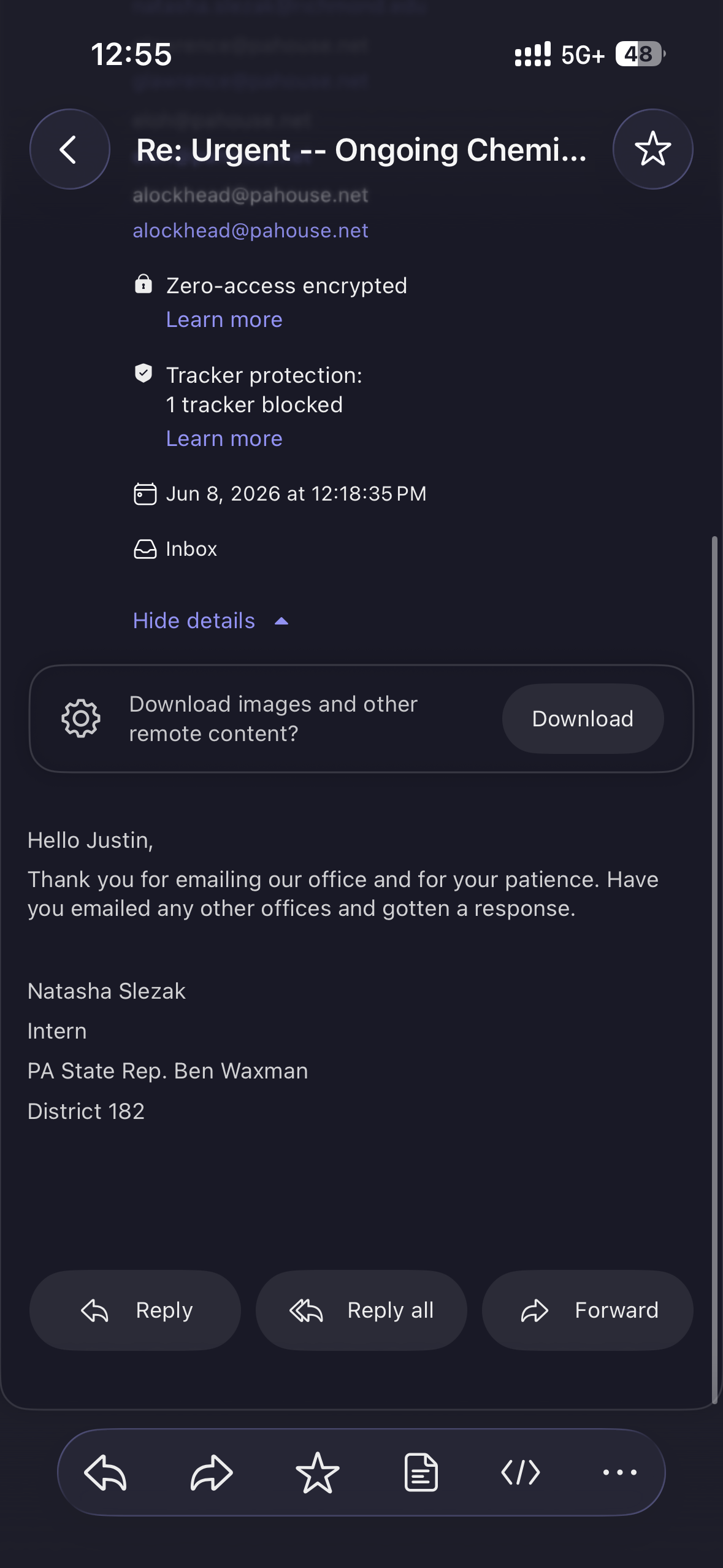
On June 8, 2026, an email chain moved through three government offices in under three hours. It did what constituent services is supposed to do: receive a problem, identify the jurisdiction, route it to the desk that can act. Here is what happened.
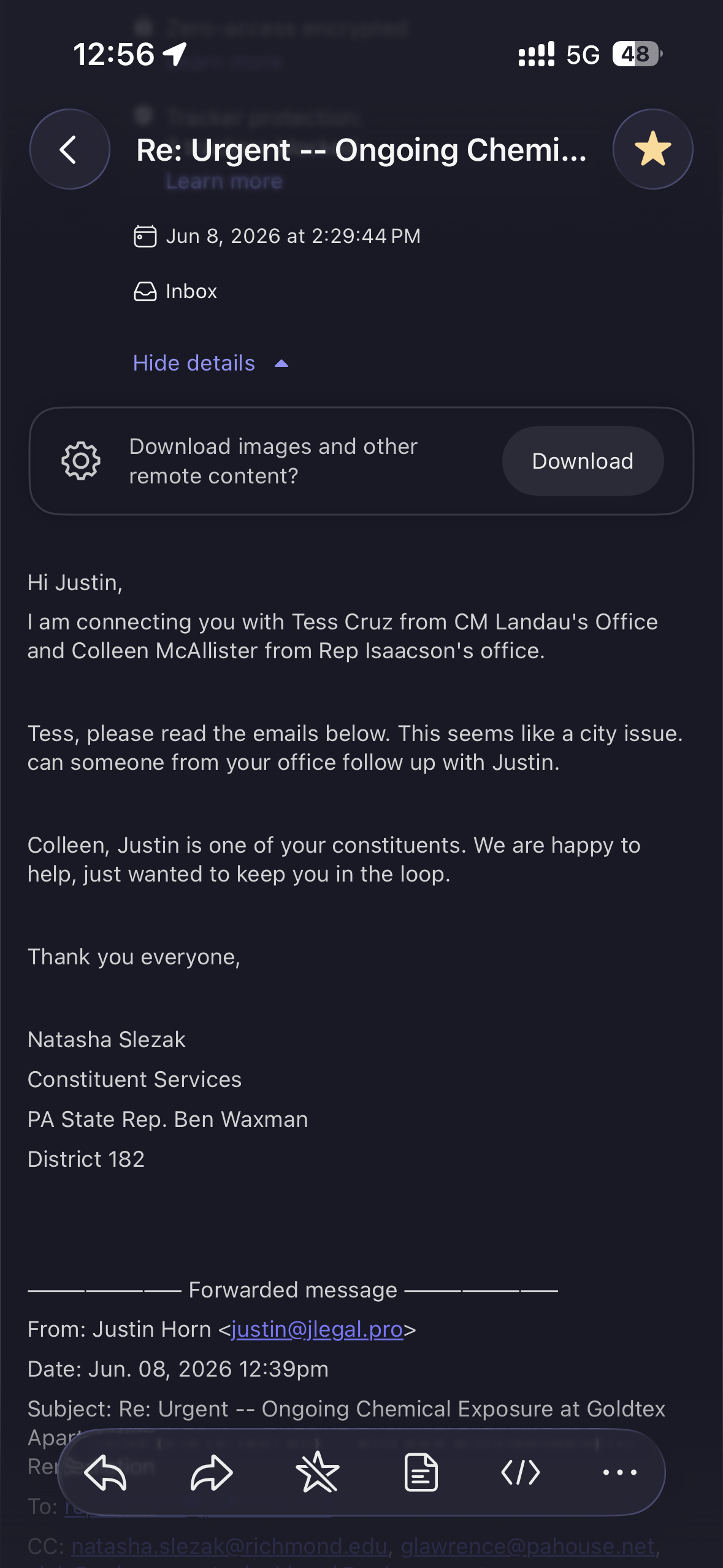
At 12:18 PM, Natasha Slezak — a junior staffer in Representative Ben Waxman’s office, District 182 (identified as “Intern” and “Constituent Services” in her two email signatures) — responded to an email about chemical exposure at the building. By 2:29 PM, Slezak had routed the matter to the city level, connecting with Tess Cruz in Council Member Rue Landau’s office and Colleen McAllister in Representative Mary Isaacson’s office, District 175 — the home-district representative for Goldtex.
Slezak wrote: “This seems like a city issue. can someone from your office follow up with Justin.”
This was correct triage. L&I, Fair Housing, and PCHR are all city agencies under the Mayor. According to the field guide, Council Member Rue Landau spent twelve years running the Philadelphia Commission on Human Relations and the Fair Housing Commission — the exact agencies with jurisdiction over housing discrimination claims.
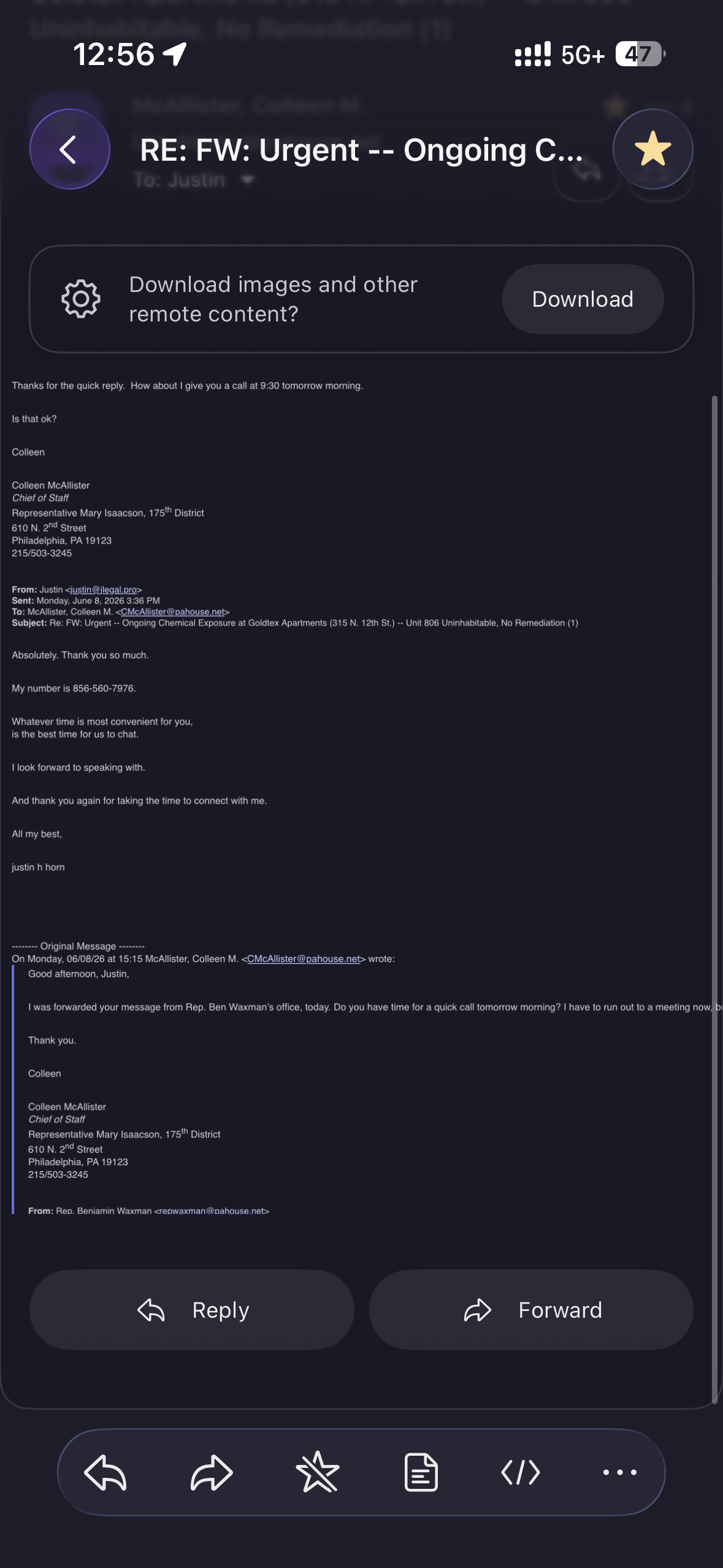
One office responded. Colleen McAllister at Representative Mary Isaacson’s office scheduled a 9:30 AM call after receiving the routing from Natasha Slezak. In a chain where every other institution was silent, Isaacson’s office engaged. That is on the record too.
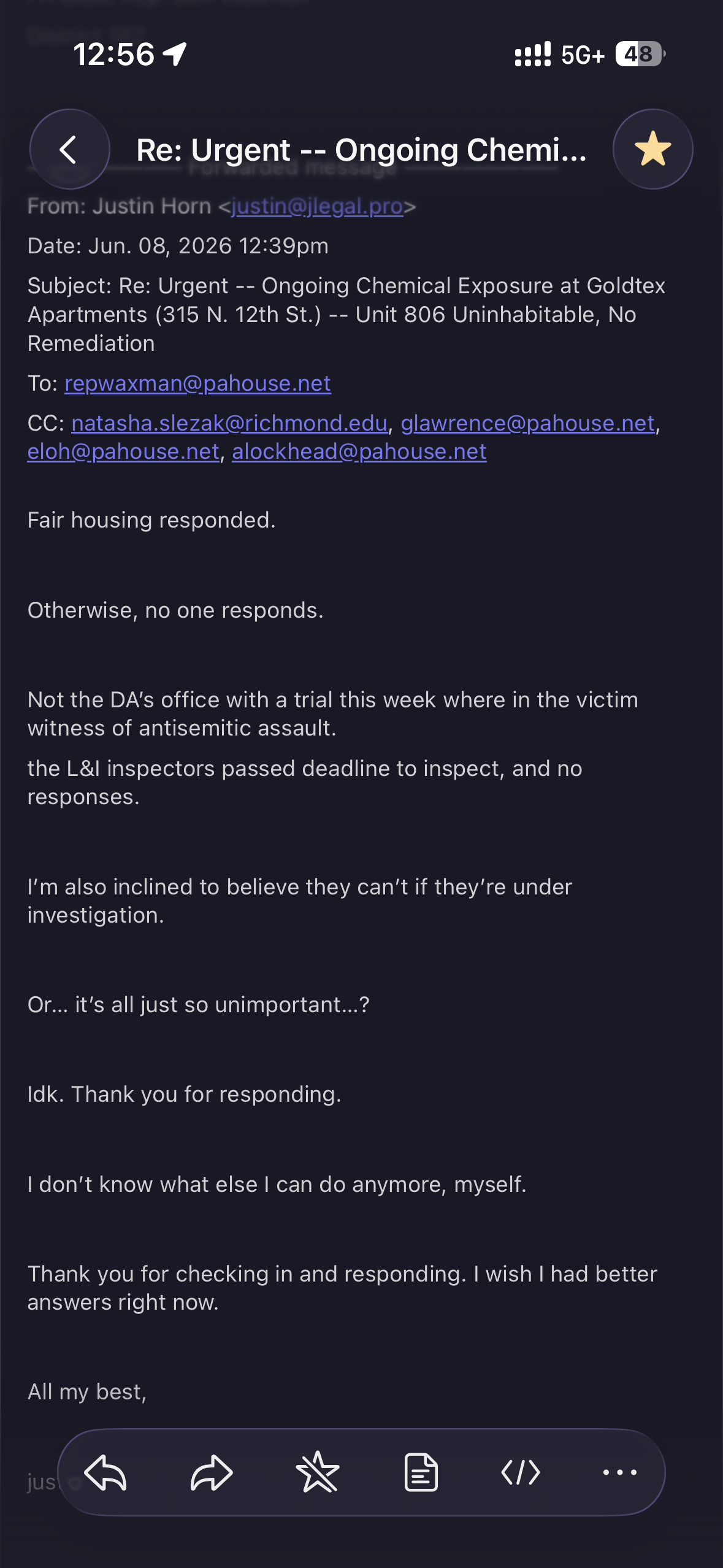
“Fair housing responded. Otherwise, no one responds. Not the DA’s office with a trial this week where in the victim witness of antisemitic assault. the L&I inspectors passed deadline to inspect, and no responses.”
— Justin Horn, June 8, 2026 email chain
The email reached every correct desk. The routing was documented as correct. What followed — or did not follow — is documented elsewhere on this site.
Structural note: A disclosed public-record fact: Rep. Ben Waxman previously served as press/communications director for DA Larry Krasner. Krasner’s DA office is the same one where four ADAs have not produced the bodycam footage. This is a public-record relationship, not an allegation.
How Three Governments Work (PDF) — reference document on federal, state, and city jurisdiction for this case.
The Invariant
There is a question every reader of this page will eventually ask, and it is better to confront it directly: is this a pattern, or is this a coincidence?
Here are the terms. Each is documented elsewhere on this site. What this section does is line them up and ask one question: what stays constant?
- 1 August 22, 2025 Front desk makes false statements to police — statements later proven false seed the “aggressor” claim and the assertion that no footage exists. The full building footage would have contradicted both statements immediately.
- 2 Preliminary Hearing, 2025 Judge orders footage preserved — the one lever that could force the full recording into the open. The footage’s existence is judicially acknowledged.
- 3 Late 2025 Case dismissed, refiled — the preservation order is never re-checked. The lever decays. The footage remains unproduced for months to come.
- 4 Pre-trial motions Defense moves to mute the audio — the motion, if granted, would suppress the one piece of existing evidence that contradicts the “aggressor” theory. Without audio, the narrative remains unchallenged.
- 5 Nine months, four ADAs No subpoena for the footage — the lever that could compel production is never pulled. Four prosecutors are assigned sequentially. None issues the subpoena.
- 6 Late May 2026 Robert Nowakowski surfaces the 38.9-second clip — approximately two weeks before the originally scheduled June 12 trial (now July 21 after continuance), after six months of no contact, unsolicited. He was evicted from the building four days before the assault and subsequently accepted approximately $16,000 in forgiven arrears. When asked directly when he obtained the video and why he surfaced it now, he did not answer either question. The clip provides prosecution evidence but does not contain exculpatory footage for the victim. (Full transcript)
- 7 June 2026 DA goes silent — no production, no reply, no pre-trial contact with the victim-witness. The lever stays unpulled through trial.
- 8 June 9–11, 2026 ADA Lay categorizes the building’s conduct as “landlord-tenant” — conduct I contend is criminal — refuses to subpoena building surveillance footage, refuses continuance to secure it, tells the victim-witness “you are not entitled to discovery.” On June 11, the building’s outside counsel sends a letter to the victim’s father (not the tenant) calling the chemical exposure “unfounded.” Same day, ADA Lay refers victim to Community Legal Services. Continuance granted. The footage remains unsubpoenaed.
- 9 Spring 2026 L&I inspects building, skips Unit 806 — the same invariant on the habitability axis. The one unit with documented chemical exposure, the one unit generating complaints, is the one unit not inspected.
- 10 July 2, 2026 The lever finally gets pulled — nine months after the preservation order, three weeks before the rescheduled July 21 trial, ADA Lay subpoenas the building footage directly and receives it: roughly 12 minutes from the front-desk camera, 2 minutes from the elevator lobby. The bodycam footage remains unsubpoenaed.
What I see when I line these up: nine independent actors, nine months, one constant output until the very end — the full footage stayed out of the record while the victim’s exoneration never entered it, until a subpoena three weeks before trial finally produced it. The question this pattern raises, in my view, is whether every actor independently made the same mistake in the same direction by coincidence for nine months, or whether the delay was not a mistake at all. This page presents the documented evidence. The reader can determine which explanation requires fewer assumptions.
Named frameworks: Three academic frameworks describe patterns similar to the one documented above. Michel Foucault described “a coherent, rational strategy, but one for which it is no longer possible to identify a person who conceived it — strategy without a strategist.” Jennifer Freyd coined “institutional betrayal” for institutions meant to protect someone instead harming them. Derrick Bell’s “interest convergence” explains how independent actors align when their self-interests point the same direction. Whether these frameworks apply to the pattern documented here is a question the reader can evaluate against the evidence.
Legal Framework
This is not a law review article. It is a reference table. Each statute below maps to a specific documented action on this site.
| Statute | What It Covers | Fit |
|---|---|---|
| 18 Pa.C.S. §4952 | Witness intimidation | Arguable — front desk statements to police are documented; whether they constitute “intimidation” under the statute requires showing intent to influence testimony |
| 18 Pa.C.S. §4910 | Tampering with evidence | Strong — footage was not produced despite a judicial preservation order; non-production is documented |
| 18 Pa.C.S. §5101 | Obstruction of justice | Strong — documented false statements to police that redirected the investigation toward the victim |
| 18 U.S.C. §1519 | Concealment of records | Arguable — footage non-production in a matter that may fall within federal jurisdiction if the hate crime is federally prosecuted; federal nexus is not yet established |
| 18 U.S.C. §1512 | Federal witness tampering | Arguable — Robert’s conduct and timing |
| 18 U.S.C. §1513 | Retaliation against witness | Arguable — eviction timing inside witness window |
| 42 U.S.C. §3617 | Fair Housing Act retaliation | Arguable — adverse action follows protected activity; temporal proximity supports an inference of retaliation, but causation must be independently established |
This page proposes the term evidentiary displacement to describe the introduction of narrower evidence that functionally displaces the demand for broader evidence which would have revealed systemic misconduct. No published case uses this exact phrase. The component doctrines — spoliation, Brady materiality, constructive concealment — are all well-established. Whether a single term is needed for their intersection is an open question.
The full footage exists or it has been destroyed. If it exists, any actor with subpoena power can obtain it. If it has been destroyed in violation of a judicial preservation order, that fact is itself evidence. Either way, the record is incomplete, and this page will be updated as it becomes less so.
June 11 update: Continuance granted in Commonwealth v. Talley. New trial date: July 21, 2026. Third chemical re-exposure documented during L&I inspection of Unit 806. Physician letter confirms re-exposure symptoms. Cohen Marraccini LLC letter calling exposure “unfounded” contradicted by FLIR thermal imaging, IoT sensor data, physician documentation, ambulance transport, and SERVPRO’s refusal to remediate. VOC Investigation Handbook, VOC Remediation Guide, and VOC investigation methodology page published.
June 12 update: Formal complaint submitted to the United States Attorney’s Office for the Eastern District of Pennsylvania (USAO-EDPA), addressed to the Civil Rights Unit, requesting federal review under 18 U.S.C. §§ 1512, 1513, 1519, 241, 242, and 42 U.S.C. § 3617. The office is led by U.S. Attorney David Metcalf, a former federal prosecutor whose background includes organized crime and violent crime prosecutions, service as Senior Counsel to the U.S. Deputy Attorney General, and an award for Excellence in the Prosecution of Organized Crime. Same day: Greystar incident report IR-GL-116844 filed by Nicole Cordial, based on a security guard’s secondhand account of a conversation with the tenant 16+ hours earlier. Management called police. The report was filed on the same day as the “unfounded” letter and the continuance — three actions against the victim-witness on a single day, which in my view fit the pattern this page documents rather than reading as coincidence. Subpoena received for rescheduled trial (July 21, 2026). DOJ Civil Rights Division confirmed receipt and assigned a case reference number for the housing discrimination report filed May 31. The tenant’s direct written response to Cohen Marraccini on June 11 asked for one thing: time to get out safely. The building’s response was a false police report and silence. Over 50 press notifications were sent on June 12 to national and local media outlets and Jewish organizations. The VOC Investigation Handbook — a 42-chapter source-attribution guide — was published to document what “investigated” actually requires.