- Property
- Goldtex Apartments · Unit 806, 315 N 12th St, Philadelphia, PA 19107
- Owner
- Post Goldtex LP
- Manager
- Greystar
- On-site
- Nicole Cordial, Senior Community Manager
- Resident
- Justin Horn
- Compiled
- April 28, 2026
Companion to the Goldtex Combined Forensic Report v3 and the Case File Working Document.
This page is a structural reading of a single document: the building-wide email Greystar sent at 4:27 PM on April 28, 2026. It is a companion to The Unauthorized, which documents the same event as a first-person narrative. Here I read the email itself — what it does, and what it cannot do.
The email text below is reproduced verbatim from the copy neighboring residents received. The four documents and two attorney emails referenced are contemporaneous records. Where I draw a conclusion from those facts, I mark it as my reading or my analysis. This is a documented structural analysis, not legal advice; I am not an attorney.
The email proves itself
Sent to everyone the email is about — except him.The April 28, 2026 building-wide email was sent at 4:27 PM in response to factually accurate flyers about the building’s expired residential rental license. In five short paragraphs, it does three things. It declines to identify any inaccuracy in the flyers. It admits in writing that the license is in renewal and that items remain outstanding with the City. And it tells residents to seek accurate information in person, from the management office. The subject of the email — the resident it describes as “an individual resident” — was not on the distribution.
The April 28 email
Subject: “Unauthorized Flyers.” Reproduced verbatim.Reproduced exactly as neighboring residents received it:
Dear Residents,
We want to take a moment to address flyers that have recently been posted and distributed throughout the building. These materials are not being distributed by management or the City of Philadelphia.
The flyers are being circulated by an individual resident and do not reflect official communications regarding the property. For accurate information, please rely on direct communications from the management team.
We are actively working with the City of Philadelphia regarding our license renewal and are taking the necessary steps to address all outstanding items. We appreciate your patience and understanding as we continue to work through this process.
If you have any questions or concerns, please reach out to the management office directly.
Thank you,
Management Team
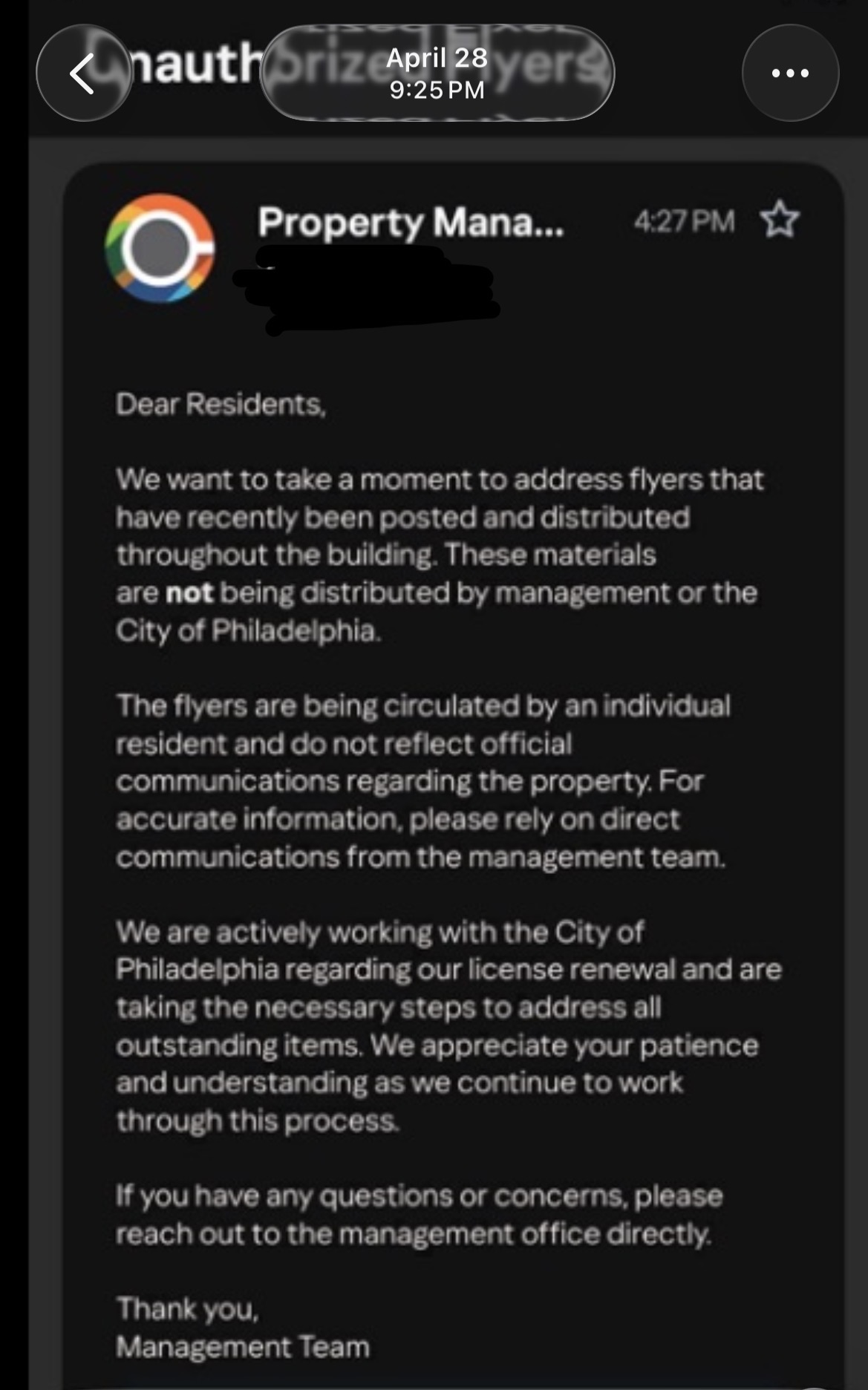
The email never identifies a single inaccuracy in the flyers, because the flyers were accurate. In my reading, four phrases carry the whole message — two admissions, two structural:
- “license renewal”AdmissionConcedes the license is not current. An active license is not a license being renewed.
- “outstanding items”AdmissionConcedes items remain unresolved with the City of Philadelphia. The flyers said exactly this.
- “an individual resident”StructuralRefers to the subject to the whole building without addressing the subject. He is described to everyone and included in nothing.
- “for accurate information … the management team directly”StructuralRoutes residents off the written record into an in-person conversation that leaves no record.
In my analysis, the email does not correct the flyers. It concedes their core fact, then points residents toward a channel that leaves no trace.
The sealed logic
Whichever branch is true, the office visit is not about accuracy.The email tells residents to come to the office “for accurate information.” In my reading, that instruction forces a choice, and both branches lead to the same place.
Management did withhold accurate information from the building-wide email — there is something residents should know that the written message left out. Then the email is selective disclosure: telling the whole building some things while reserving others for a private room. That is misconduct.
No accurate information was withheld — the email said everything factual there was to say. Then the office visit is not about accuracy at all. The only content that still needs the verbal channel is content that cannot survive being written down: a characterization of the named individual. That is a smear.
The email’s function is not to correct the flyers. It is to direct residents to the room where the smear is delivered.
What each channel can deliver
Writing keeps a record. The office does not.A written channel produces a record — timestamps, a distribution list, signatories, retention. A verbal channel produces none of that. In my analysis, the email sorts content by which channel each piece can survive in.
Written — keeps a record
The email itself is content-empty. Its verbs are soft and procedural: “reach out,” “work through,” “address all outstanding items.” It names nothing specific and characterizes no one, because whatever is written down is preserved with a timestamp and a distribution.
Verbal — keeps no record
What is specific, characterizing, dated, and directed at a named person lives in the office visit. Residents report being told, in person, that he is “crazy,” that he “thought she was trying to kill him,” that his complaints are “paranoia.”
None of those characterizations appear in any Greystar writing. In my reading, that is not an oversight — it is the sorting. And they do not merely go unwritten; they contradict the written record that does exist: PPD Complaint #26-09-47920 and the April 10, 2026 letter from Dr. Mark Fabi, M.D. The email keeps the record clean by keeping the accusation verbal.
The third channel: physical suppression
Disposal, not preservation.The flyers themselves were careful and lawful. They cited Philadelphia Code § 9-3901 et seq., enumerated Fair Housing Ordinance rights, and directed residents to Community Legal Services, the Fair Housing Commission, and 311. They carried a “not legal advice” disclaimer, named no individual, and were signed simply: “posted by a Goldtex tenant engaged in lawful tenant organizing.”
They were found in the fitness-center trash.
Disposal, not preservation
If management believed the flyers were defamatory, the predictable response would be to preserve them — photograph them in place, date-stamp them, attach them to an incident report, build a record of the alleged wrong. Instead they were thrown out. In my reading, disposal eliminates content; it does not build a record. That is the behavior of someone making information disappear, not someone documenting a wrong.
The fitness center is keyfob-accessed, and Greystar posts its own Bilt and Rewards marketing in the very same spots. In my analysis, that narrows the set of people who could have removed the flyers to staff or those acting with staff authorization.
Three channels, one structure.
Written, physical, verbal — three different mechanisms. In my analysis they share one function: control the information environment around the resident while preventing him from accessing or correcting it.
Written
The April 28 building-wide email names him to every resident. He is not on the distribution.
Physical
His accurate flyers are pulled down and thrown out — his message removed from being seen at all.
Verbal
In the office, residents are told, in person, that he is “crazy” — where it leaves no paper trail.
The pattern is the proof.
The exclusion leaves a fingerprint. The April 15 email to his guarantor and the April 28 building-wide email both name him, both characterize his conduct, and both exclude him. Same author — Cordial — thirteen days apart.
That is not a coincidence. It is a method.
Two regimes, one pattern
The structure precedes the manager.The same structure appears under the prior management, before Greystar. On October 6, 2025 at 11:17 AM, a habitability complaint went to Ryan Siminske. It was escalated to Sara Kane. Roughly ninety minutes later, Kane sent a “Resident Conduct” letter. The complaint became the conduct problem.
That instance is pre-Greystar. In my reading, the cross-regime continuity is what matters: it converts “one manager’s overreach” into a property posture that survived a change in management company. Under Philadelphia Code § 9-804, retaliation is the strongest frame — intent need not be proven. Two instances across two managers is not an incident; it is a pattern.
Predicate, disability layer, convergence
Three independent legal frames, one set of facts.The predicate
On August 22, 2025, an eleven-minute assault in the building lobby left the resident with an orbital fracture, a broken nose, and a broken jaw. In Commonwealth v. Talley, CP-51-CR-0000673-2026, the Commonwealth charged ethnic intimidation — meaning the protected class here was established by the District Attorney, not asserted by the resident. Antisemitism reports in the summer of 2025, and again to Siminske in October 2025, are protected activity.
The disability layer
On April 10, 2026, Dr. Fabi’s letter put a mental-health concern in writing — formal, dated notice. In my reading, the verbal smear that imputes paranoia is then perceived-disability discrimination: under the Fair Housing Act, a disability need not actually exist for discrimination on the basis of a perceived one to be actionable.
The convergence
Three independent legal frames rest on one set of facts: retaliation (city ordinance); religious, national-origin, and ethnicity discrimination (FHA and PHRA); and perceived-disability discrimination (FHA). (See The Convergence for how these frames overlap.)
Independently confirmed
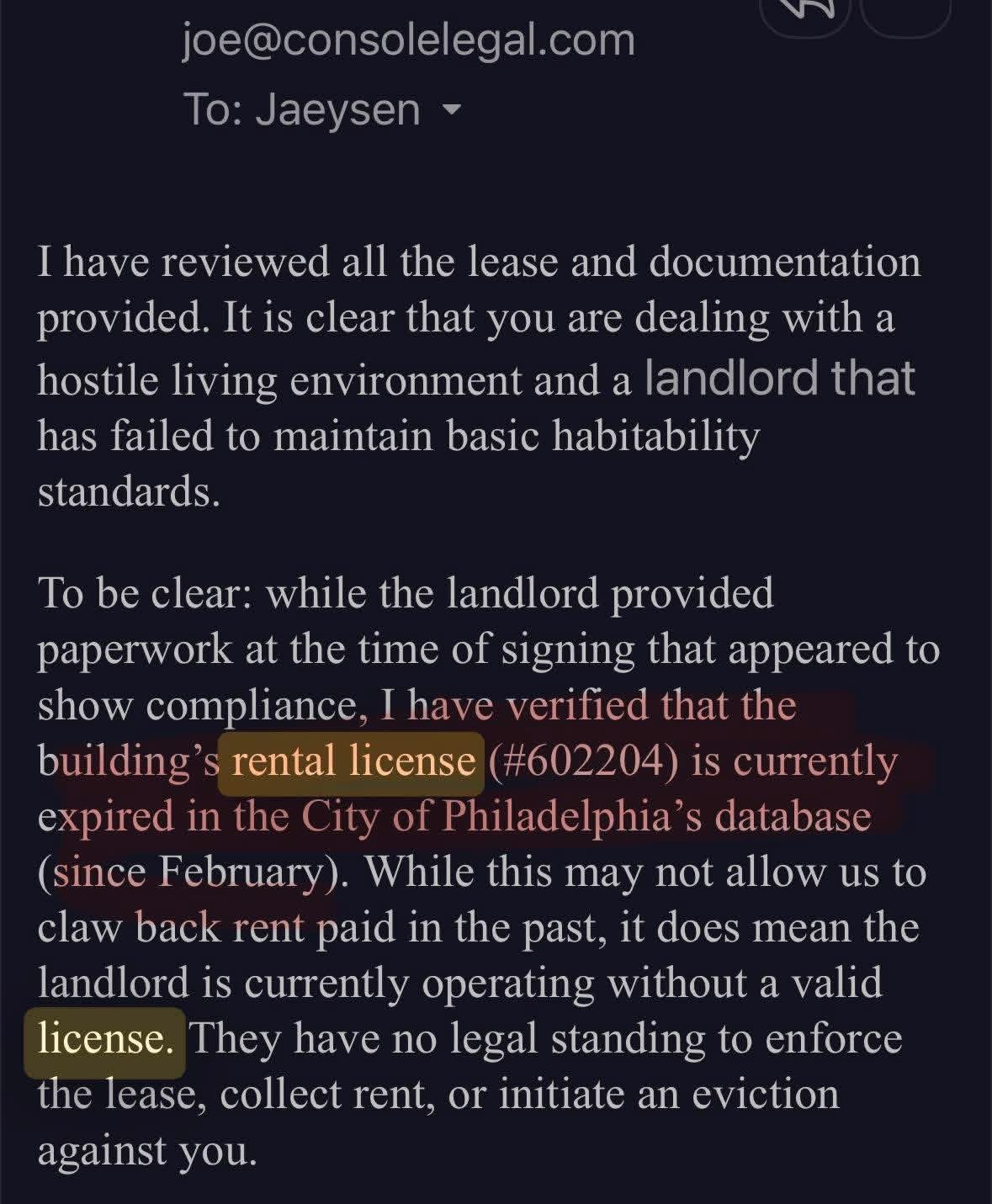
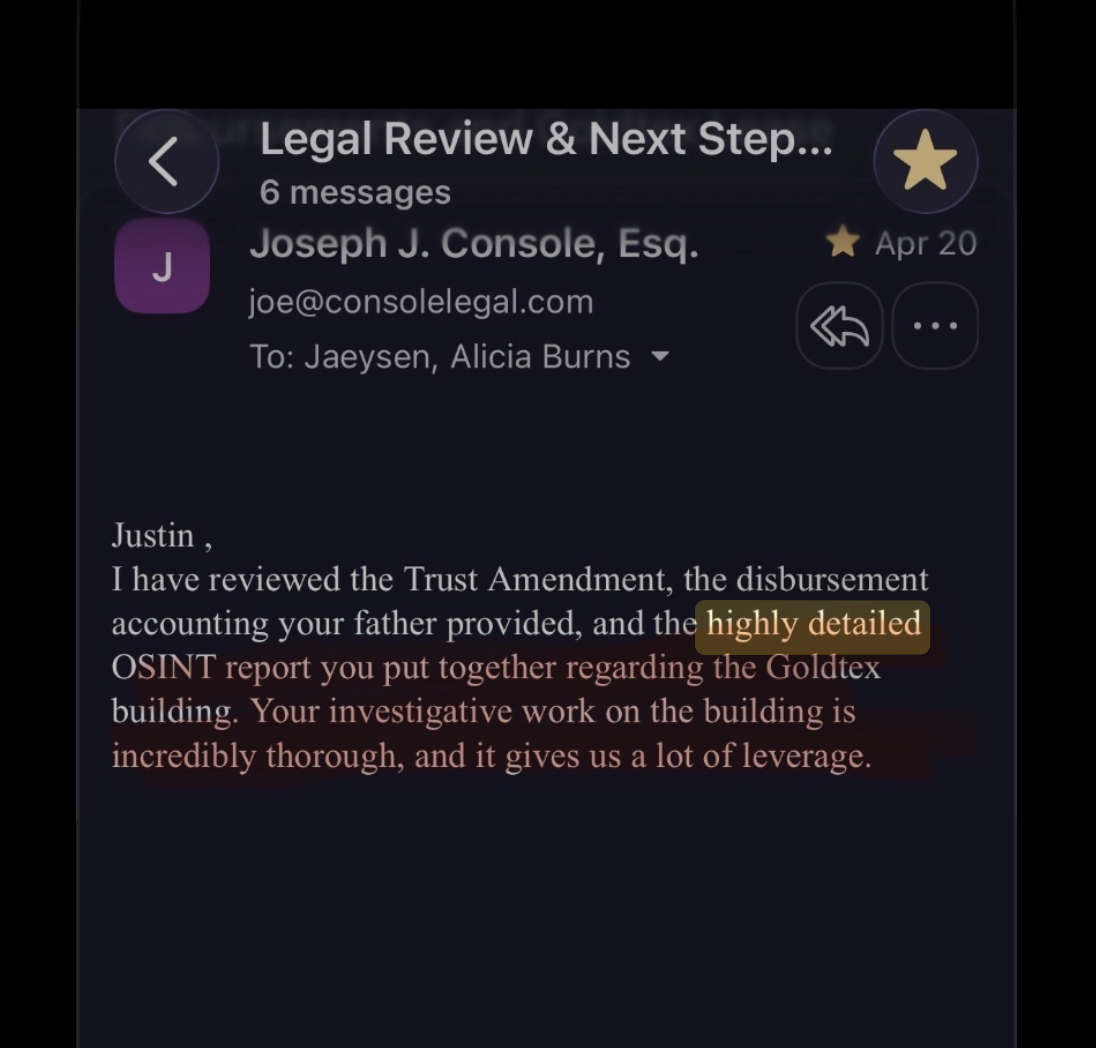
The single fact the flyers stated — that the building’s residential rental license had expired — is confirmed by the City’s own record and by the resident’s own counsel. After reviewing the lease and documentation, attorney Joseph J. Console wrote that he had “verified that the building’s rental license (#602204) is currently expired … since February,” and that the landlord “has no legal standing to enforce the lease, collect rent, or initiate an eviction.”
The state of the record
Not construction. Preservation.What follows from all of this, in my reading, is a shift in what remains to be done.
Witnesses corroborate content. The email proves structure. The flyers in the trash prove the same structure in the physical world. The Kane letter proves the structure precedes the manager.
Documents & further reading
The source document for this page, and the companion pages that document the same events: