Six facts
- A caller phoned 311 to confirm one thing: whether a rental license was actually valid during a specific window, because the last housing violation on the property — no rental license — had just closed.
- The representative pulled up eCLIPSE, the tool 311 is trained to trust, and read out a renewal date of March 1, 2026.
- That date is wrong. The city's own live data feed puts the real reissue date at August 3, 2026 — five months later, confirmed live for this page.
- She couldn't explain the gap. eCLIPSE and Atlas are the only tools 311 uses. Everything else, she said, isn't "city government." She tried transferring the call to a supervisor. The hold line disconnected.
- She said this happens a lot. Asked directly, unprompted, she confirmed callers hit this exact confusion often.
- Nobody here did anything wrong — except the tool. She read it exactly as built. The error starts upstream, in what eCLIPSE shows.
A city employee gave a caller the wrong answer to a legal question — not because she failed, but because the city's own system fed her a wrong date and called it fact.
Why she picked up the phone
A rental license at 315-23 N 12th Street — 163 units, owned by Post Goldtex LP — lapsed on February 28, 2026. The building's last open housing violation, for operating without a rental license, closed only once a new license appeared in the system.
The caller had been tracking this property since February, cross-checking the city's raw data feed against what flyering and on-the-ground reporting showed. His numbers said the license sat lapsed for over five months — not the one-day gap a "renewed March 1" date implies. He called 311 not to argue, but to find out: which system does the city actually trust, and does it agree with what he'd found?
What she read him, word for word
She pulled up eclipse.phila.gov — no login required, the tool 311 uses on every call like this — searched the license number, and read the record as active.
“So the license they had, they initially got it in August of 2013. They renewed it. So March 1st, 2026, they renewed it.”311 representative, reading from eCLIPSE
He asked if there was any way to see the license's actual history, not just its current status. Her answer was honest, and — as far as her screen goes — correct:
“There is nothing that would show the history. That's the problem.”311 representative
He told her his own numbers, pulled straight from the city's data feed, put the real reissue date in early August — not March. She couldn't square it. She reread what eCLIPSE showed, then offered to transfer him to a supervisor "so they can reach out to whatever department you're speaking on." The call went to hold. It never came back. The line disconnected.
She did nothing wrong. She read the city's own tool correctly, out loud, exactly as it told her to. The problem is what it told her.
Two dates, one license, same day Verified live
The city's underlying data feed — the same Carto-hosted system that powers eCLIPSE, Atlas, and Property History — was queried directly for this page. Here is what it says, next to what a member of the public actually sees on eCLIPSE, for the same license, the same moment:
mostrecentissuedate, Carto APIThe city's own dataset says this license was reissued August 3, 2026. The city's own public lookup tool — the one 311 hands every caller to — says March 1, 2026. Same license, same field, same instant. That five-month gap sits on the one date that decides whether a landlord had a valid license, and a legal right to collect rent, during a specific window. This isn't a missing record. It's a wrong one.
See it yourself, right now
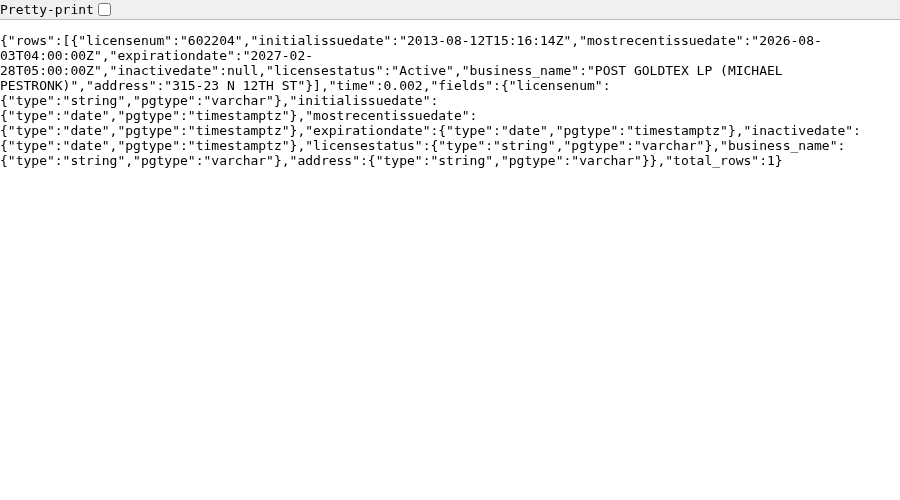
phl.carto.com), queried live for license 602204. mostrecentissuedate: 2026-08-03. Open the live query →Show as a table
| Field | City open-data API (Carto) |
|---|---|
| Initial issue date | 2013-08-12 |
| Most recent issue date | 2026-08-03 |
| Expiration date | 2027-02-28 |
| Inactive date | null |
| Status | Active |
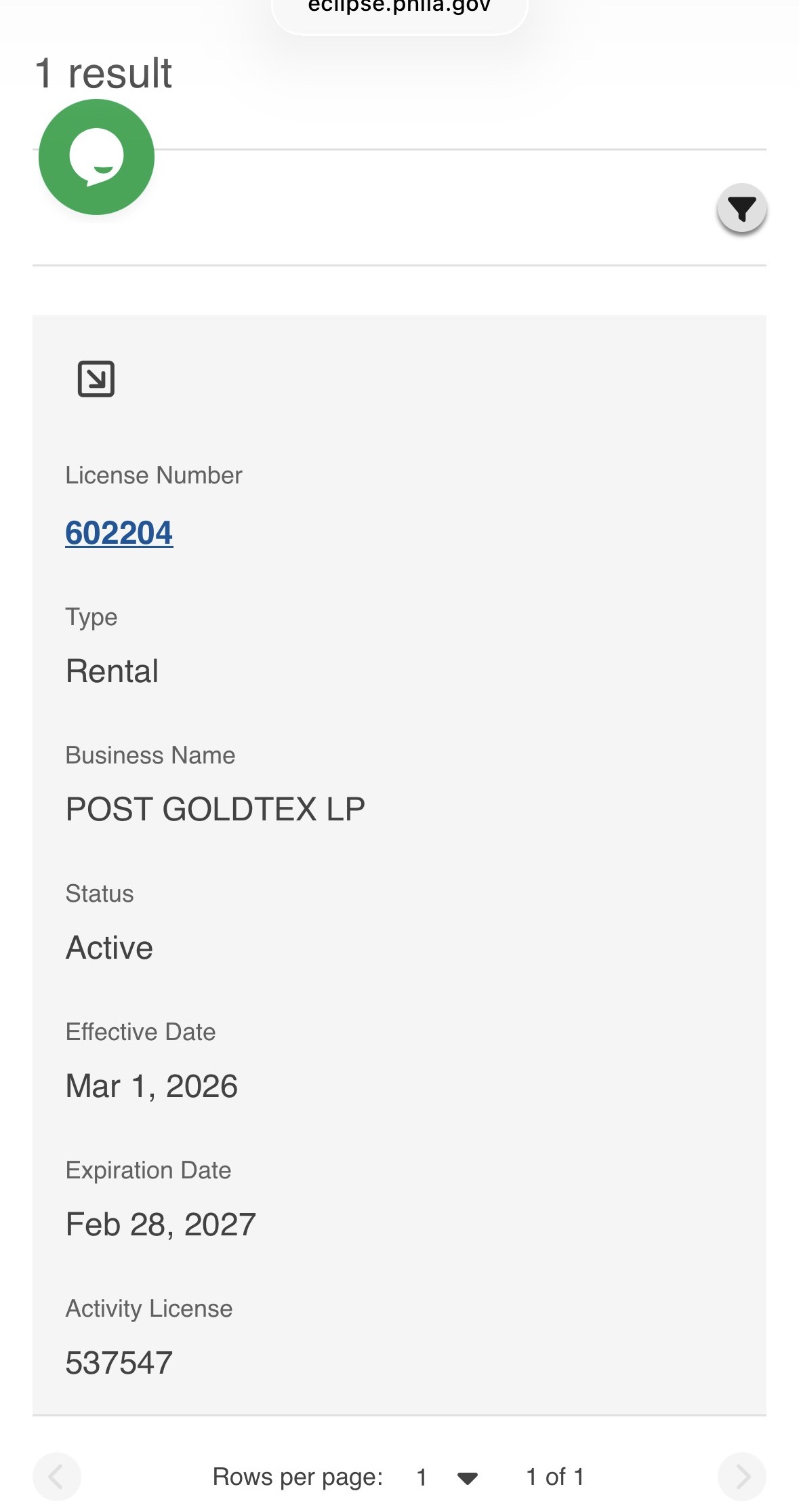
602204.Show as a table
| Field | eCLIPSE (public site) |
|---|---|
| License Number | 602204 |
| Type | Rental |
| Business Name | POST GOLDTEX LP |
| Status | Active |
| Effective Date | Mar 1, 2026 |
| Expiration Date | Feb 28, 2027 |
| Activity License | 537547 |
"A lot of calls about this"
He asked her directly: do people call about this kind of license-date confusion often? She didn't hesitate.
“Yeah, they do, and then we direct them to this page.”311 representative
Later in the call, unprompted, she drew her own line between what 311 trusts and what it doesn't — including the city's own open-data catalog:
“I would say maybe 70% of this stuff may be accurate, but I would not solely depend on anything coming from Opendataphilly.org.”311 representative
Put together: 311 reps are trained on exactly two tools. Those tools just displayed a wrong date on a real license. And by the rep's own account, this isn't rare — it's routine.
Why one license matters to everyone
A tenant, a lawyer, a reporter — anyone trying to find out whether a landlord had a valid license on a given date has exactly three options: eCLIPSE, Atlas, or a 311 rep reading from them. If eCLIPSE itself is wrong — not silent, wrong — every one of those paths lands on the same bad answer. It doesn't matter how careful you are. The system isn't failing to help. It's actively misinforming.
This is the sharpest, most concrete version yet of what "The Verification Monopoly" documents at scale: Philadelphia's property-data tools contradict each other and route the real answer through humans who have no way to check it. This case isn't two obscure map layers disagreeing in the weeds — it's the city's flagship public lookup tool showing a different number than the dataset it's built on.
None of these tools remember anything
Even when eCLIPSE's numbers are right, it can't do one basic thing: show history. It reports right now — active or lapsed, effective, expiring — never a timeline of what actually happened. So there's nothing to check the wrong date against. It's presented as current and final, with no way for a caller, a rep, or anyone without direct API access to catch it.
That underlying transaction history — when licenses like this one actually lapsed and came back — appears to still exist somewhere in the city's systems. It just isn't shown to the public, or to 311. Reconstructing it, potentially tens of thousands of records city-wide, is separately underway.
A public changelog for a system with no memory
A wrong date looks exactly like a right one until someone checks. So a public, dated changelog is being built to track every confirmed discrepancy between the city's own data systems — Carto, eCLIPSE, Atlas, Property History, L&I — as they're found, in one place, instead of every lawyer, tenant, and reporter rediscovering the same gap alone, one 311 call at a time.
Follow the changelog on GitHub → — a daily, append-only record of Philadelphia rental-license data pulled straight from the city's own open feed.
What's documented, and how
The 311 representative acted in good faith. She read her assigned tool accurately. This page holds her blameless — the defect sits upstream, in what eCLIPSE displays.
eCLIPSE displays the wrong renewal date for license #602204. Documented by a caller screenshot of the public lookup.
The city's own Carto API puts the real reissue date at August 3, 2026. Documented by a live, independently reproducible query.
Every quote here is on the record. Documented by a recording of the call and its machine transcript.
The two dates are five months apart. Measured directly from the two sources above.
Bottom line
A Philadelphia 311 representative, working entirely from the city's own tool, told a caller a rental-license date that was five months wrong. She said this happens a lot. Nobody on that call did anything wrong — the tool was wrong, and right now, there's no way for a caller or a 311 rep to catch that on their own.
Call record: 311 call, Aug 21, 2026, license #602204 (315-23 N 12th St). Recording and machine transcript (faster-whisper large-v3) held by the author. Data verification: City of Philadelphia open-data feed, queried live via phl.carto.com/api/v2/sql, table business_licenses, license 602204. eCLIPSE record: caller screenshot of eclipse.phila.gov, license #602204, taken Aug 22, 2026. This page offers information, not legal advice, and alleges no intentional wrongdoing by anyone named or referenced.