Two things happened in my unit on April 8, 2026, in the same hour, with the same L&I inspector, and his own photos document both. He closed a no-heat complaint that his own readings contradicted. And he stood in front of a portable AC exhaust hose, taped together with foil tape and running over 100°F, and recorded nothing about it. That hose is what put me in an ambulance on May 6.
This page lays out the inspection, the hazard, the "fire hazard" story Greystar built the same week, and how L&I Supervisor Anthony Williams and Councilmember Mark Squilla handled it from April through October. Everything is sourced: the City's own eCLIPSE record and the inspector's timestamped photos, produced to me under the Right-to-Know Law on November 6, 2026; my FLIR thermal images; my room sensor log; emails from Williams and Squilla; and City campaign-finance and property records.
1. The inspection: 65 minutes from case file to "closed"
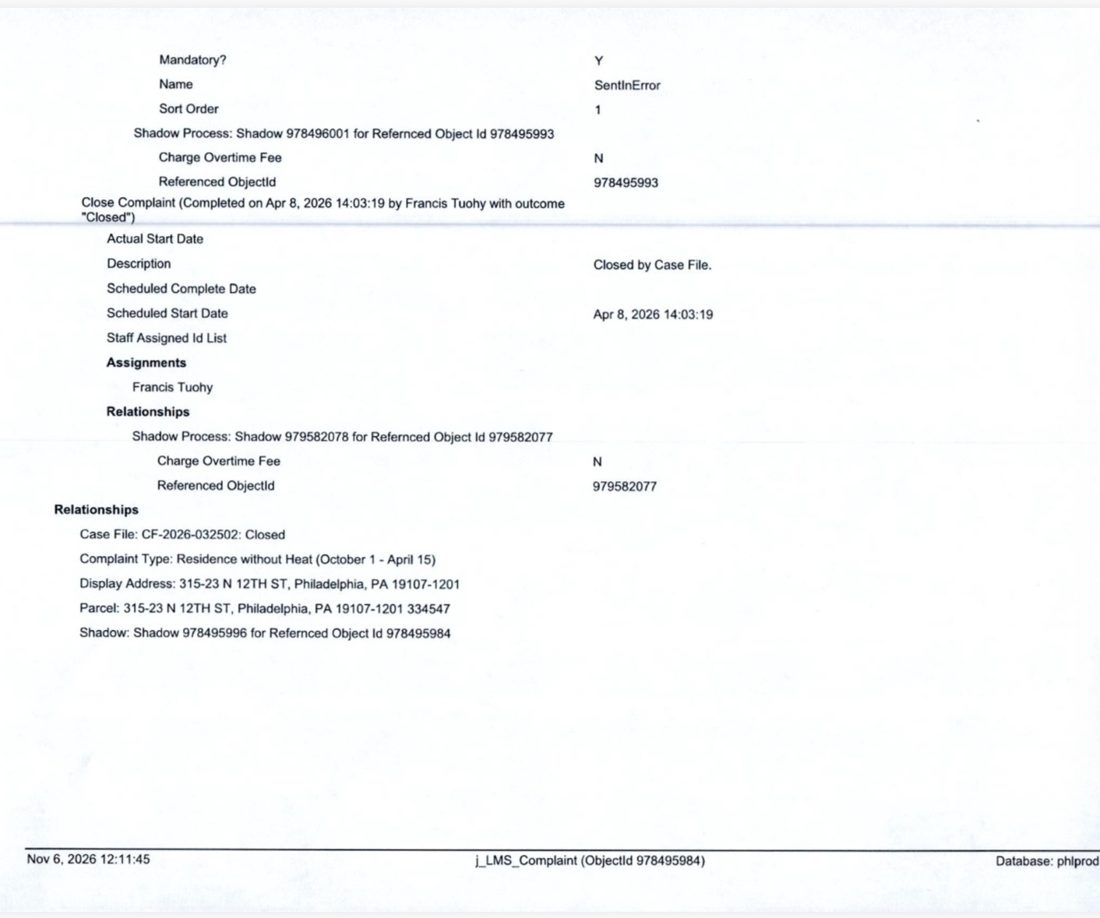
I filed a 311 complaint for no heat on April 6, 2026 at 1:30 PM. The City logged it as CM-2026-031537, complaint type "Residence without Heat (October 1 – April 15)." Inspector Francis Tuohy reviewed it on April 8 at 12:58:24 PM and created case file CF-2026-032502. He closed the complaint at 2:03:19 PM the same day, "Closed by Case File," no violation.
When he arrived he told me he wasn't the inspector who was supposed to be there, but that he's at this building a lot. He told me he's been doing this for 25 years.
| Time, Apr 8 | What his photos show | Source |
|---|---|---|
| 12:58 PM | Case file CF-2026-032502 created by Francis Tuohy | eCLIPSE history |
| 1:00 PM | Building entrance | Inspector photo |
| 1:04 PM | Door of Unit 806 | Inspector photo |
| 1:06 PM | Wall thermostat: heat mode, set to 86°F | Inspector photo |
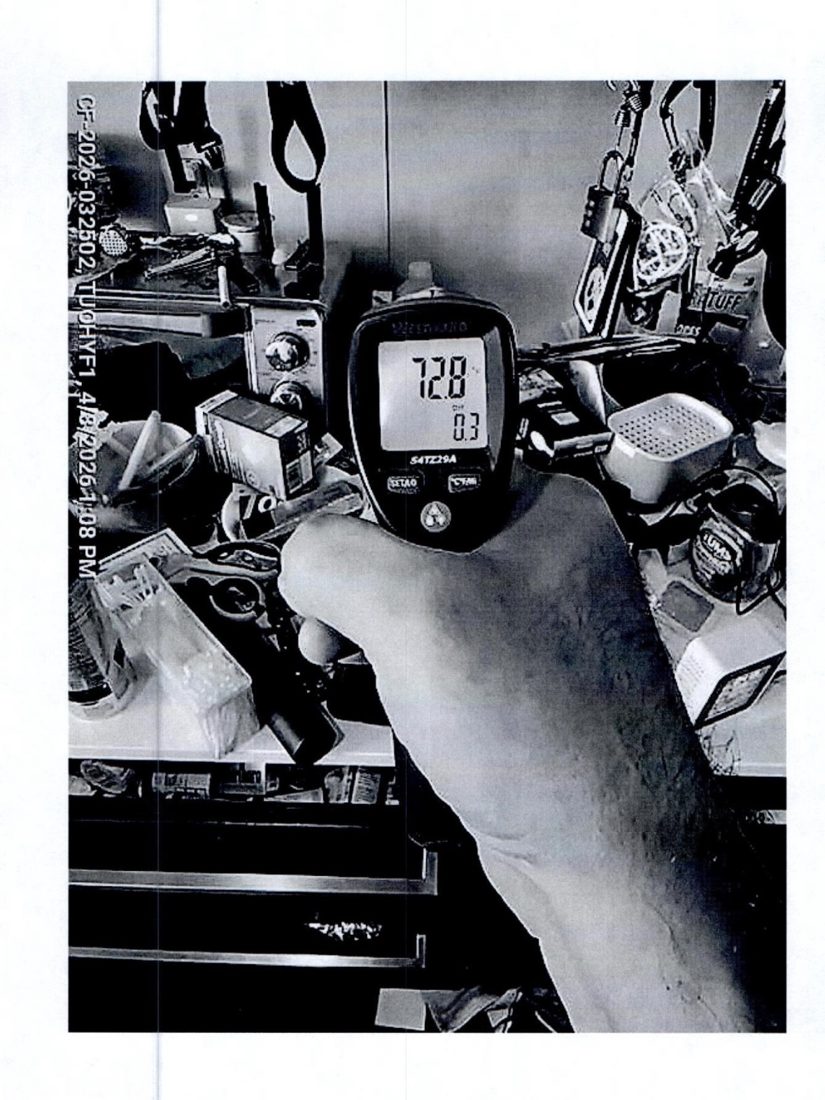
| 1:08 PM | Temp gun on kitchen backsplash: 72.8°F | Inspector photo |
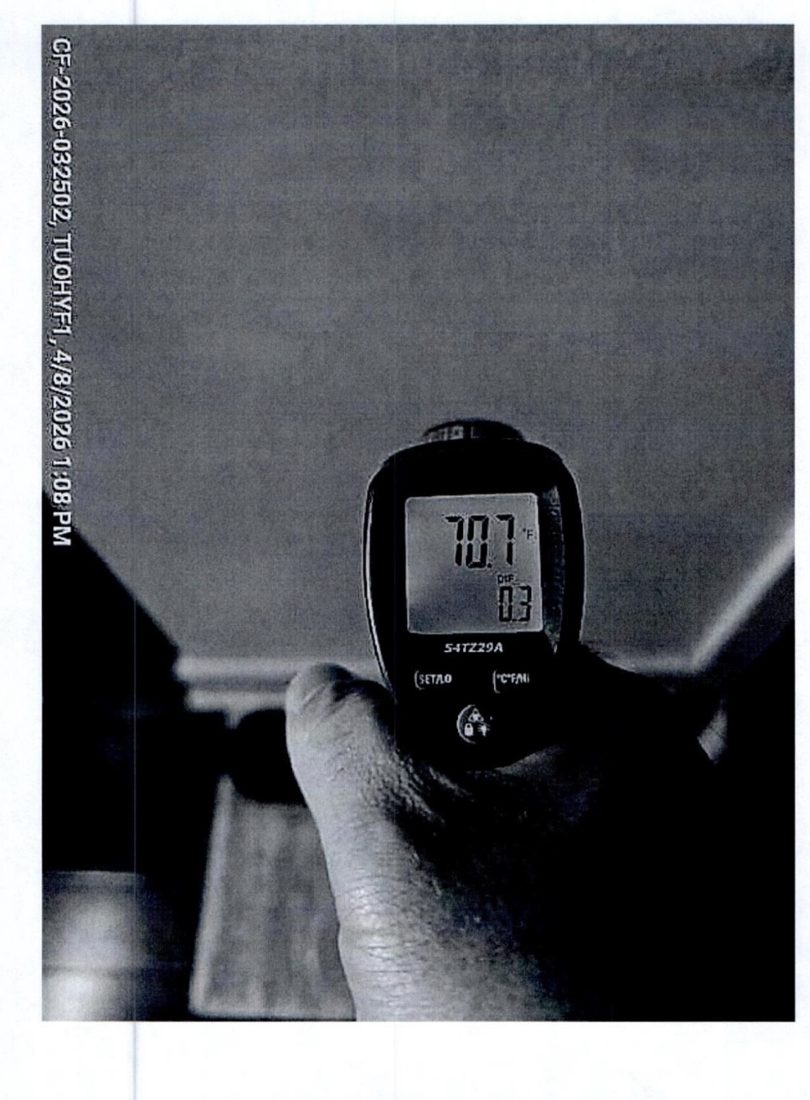
| 1:08 PM | Temp gun aimed up at the ceiling: 70.7°F | Inspector photo |
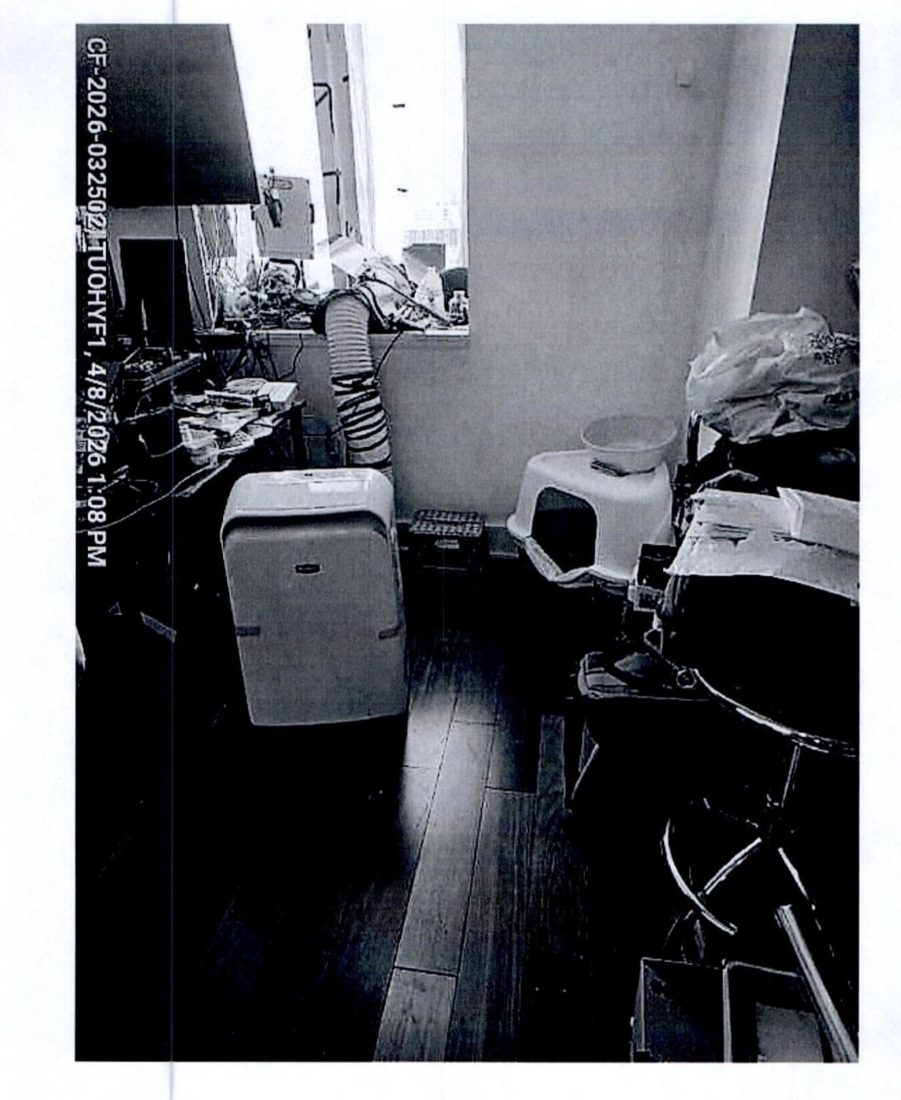
| 1:08 PM | The room, with the portable AC unit and taped exhaust hose in frame | Inspector photo |
| 1:10 PM | Temp gun on the exposed ceiling supply duct: 73.7°F | Inspector photo |
| 1:18 PM | Trash chute in the hallway, away from my unit | Inspector photo |
| 1:38 PM | Fire alarm control panel in the lobby, fire-watch log attached | Inspector photo |
| 2:03 PM | Complaint closed. No violation. | eCLIPSE history |
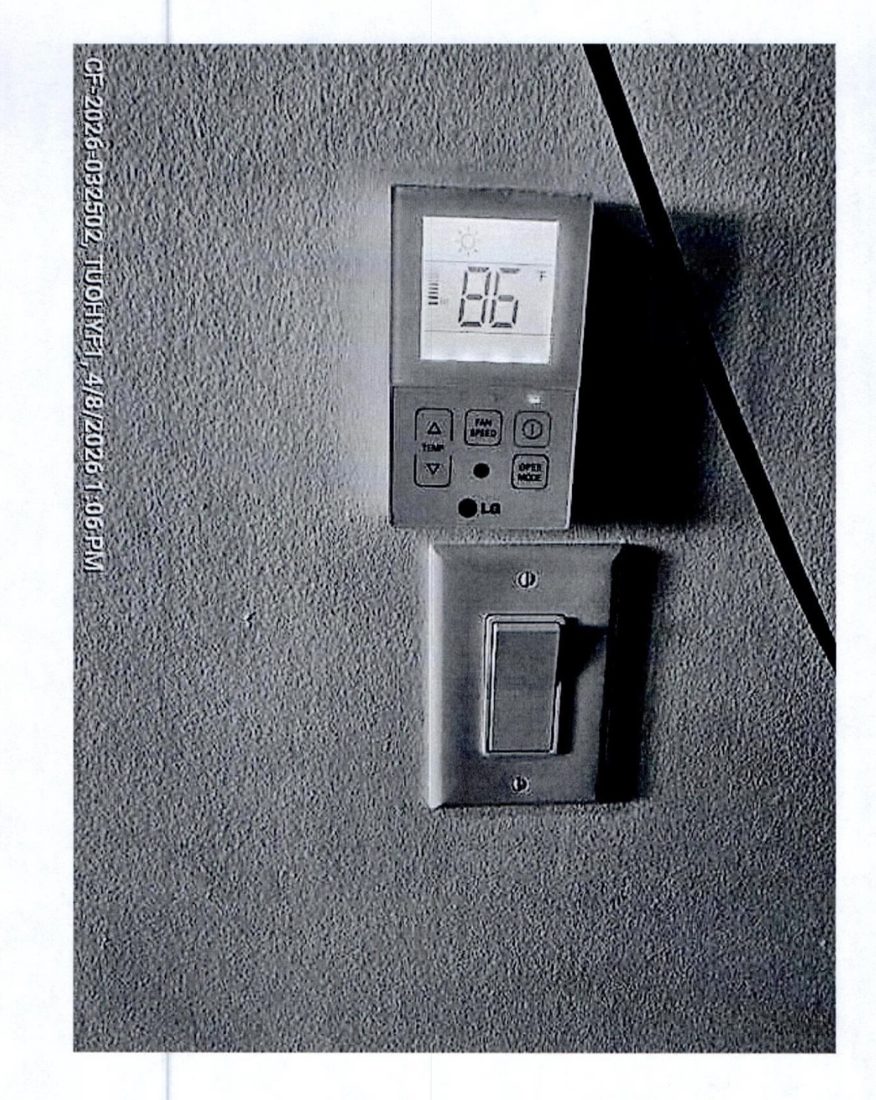
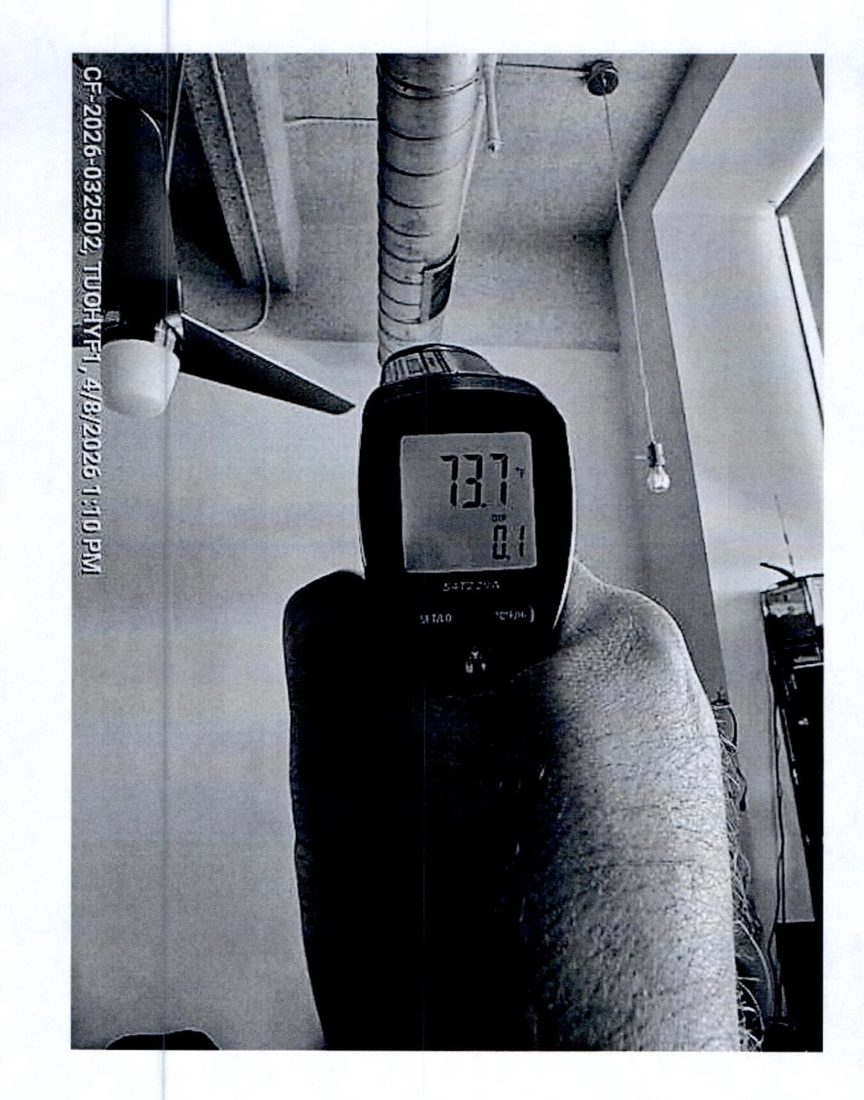
A supply duct at room temperature while the thermostat is calling for 86 means no heated air is moving through the system. There is no other way to read it. A separate temperature/humidity sensor in the unit logged hourly readings through this period: 67.8°F at 7 AM on April 6, the morning I filed; 70.3°F at 7 AM on April 8; 72.7°F at 1 PM, during the inspection. The sensor and the inspector agree. The unit was in the low 70s with the heat set to 86.
2. The gun: why the readings were accurate
I had assumed for months that the inspector's reading was manipulated. Now that I have his photos, I can say exactly what the gun was doing, and the honest answer is that his numbers were right.
The small number under each temperature is labeled DIF. On this class of infrared thermometer, DIF is the spread between the highest and lowest value captured while the trigger is held. It is not emissivity. 0.3 means the reading moved 0.3°F during the scan; 0.1 means it barely moved. Emissivity is shown separately on these guns and defaults to 0.95. Nothing in the photos shows it was changed.
| Surface | Reading | DIF | Does 0.95 fit? | Effect |
|---|---|---|---|---|
| Plexiglass backsplash (acrylic) | 72.8°F | 0.3 | Yes. Acrylic is opaque to thermal IR, emissivity roughly 0.85 to 0.92, about 10% reflective. | Accurate to within a degree or two. Matches my sensor's 72.7°F. |
| Ceiling | 70.7°F | 0.3 | Yes. | Accurate. |
| Ceiling supply duct (metal) | 73.7°F | 0.1 | Yes if painted. If bare galvanized, 0.95 makes the gun read mostly reflected room temperature. | Accurate if painted. If bare metal, a warm duct would read low, not high. A duct carrying heated air would still have shown high 70s or above. |
3. What was standing next to him
At 1:08 PM he photographed the room. In that photo is the portable AC unit Greystar hooked up when the building's heat failed, with its exhaust hose: two tubes joined with FSK foil tape and run out the window. It was already installed when he walked in.
Two days earlier, on April 6 at 2:50 PM, my FLIR thermal camera had that taped joint at 112 to 114°F with the unit running. I showed the inspector those FLIR photos while he was in the unit.
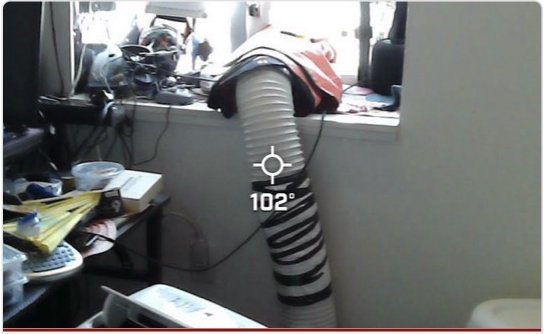
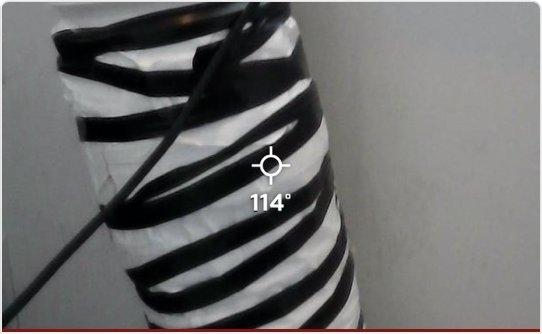
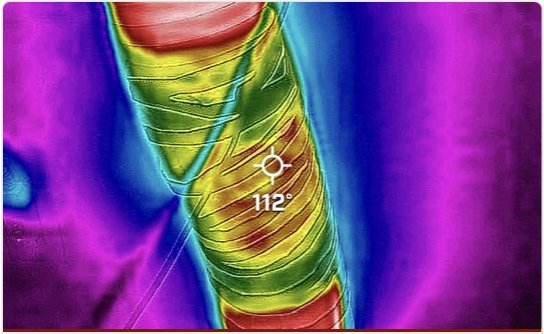
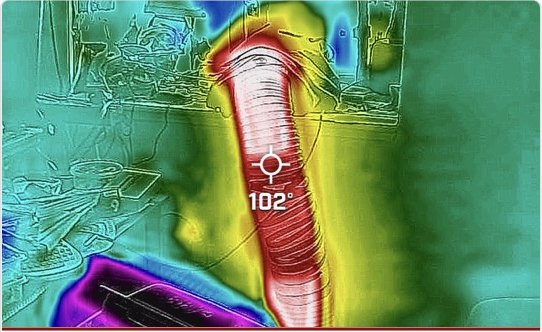
FSK (foil-scrim-kraft) tape is an HVAC product. It is not rated for continuous heat at those temperatures. The adhesive cooks and releases toluene, xylene, styrene and formaldehyde, and the emission rate roughly doubles for every 10°C above the 23°C baseline at which tape emissions are tested. A single-hose portable AC creates negative pressure, so it pulls that air straight back through its own intake into the room you're breathing in. The unit's one window opens a few inches. That is the exposure. On May 6 it sent me out in an ambulance. A physician's April 10 letter documents the reported contaminants and concern; a May 21 letter advised me in writing not to re-enter the unit while the conditions were unresolved.
The hottest thing in that room was a taped exhaust joint, and he was holding a temp gun he had just used on a duct. He never pointed it at the hose. He never wrote it down. It is in his photo and nowhere in his file.
In the elevator on his way out, he told me there could be a fire hazard in my unit and that he'd have to tell management. He didn't say what it was.
And it did more than miss the hazard. It delayed me finding it. A city inspector stood in front of that unit, looked at my FLIR photos of it, and let it stand. That reads as a pass. For weeks afterward I was getting sick and looking everywhere but the one thing L&I had just looked at and said nothing about. If he had said one word about that hose on April 8, I would have pulled it the same day instead of ending up in an ambulance a month later.
4. The "fire hazard"
The same day as the inspection, April 8, a Goldtex staff member started texting me. He told me the manager had said there was a fire hazard in my unit and had instructed him not to tell me. He told me anyway, because he thought that was wrong. He said he didn't know what the hazard was. He came up to my unit that night to look for it with me. The texts exist and are dated.
Here is what the written record then shows, in order.
| Date | Event | Source |
|---|---|---|
| Apr 8 | Inspection. Staff texts about a "fire hazard" begin the same day. | Texts |
| Apr 13 | Greystar's non-renewal letter is dated this day (footer later reads "Revised 4/14/2026"). | Letter |
| Apr 14 | I record a leasing-office exchange with manager Nicole Cordial. Cordial calls the police on me; I am cleared (DC #2609047257). The same day, Greystar demands the portable AC back while a recording captures the office offering an identical unit to a prospective tenant. | Video; PPD report |
| Apr 15, 8:00 AM | Cordial emails my father, the lease guarantor, not me: "the city has deemed the unit a potential fire hazard," given as a reason not to renew my lease. | Cordial email |
| Apr 24 | L&I Supervisor Anthony Williams, in writing, with the Office of the Inspector General copied: "There is no documentation or report of a fire violation for that unit." | Williams email |
| Apr 24 | Councilmember Squilla, Reply-All on the same thread: "We did ask L&I to address and would love to know what the fire hazard is that is being reported." | Squilla email |
Williams also explained where the claim came from. During the inspection, management asked the inspector whether the storage in my unit could potentially be a fire hazard. The inspector said it could, and declined to cite it:
"...the inspector was asked if the storage in the unit could potentially be a fire hazard, to which he responded yes. The inspector did not deem the potential high enough to issue a violation on the occupant for the storage at the time of inspection."Anthony X. Williams, L&I, April 24, 2026
That is the whole origin of the "fire hazard." A leading question from management and a no from the inspector. The City disproved it in writing within nine days. What Greystar told my father on April 15 was a lie, and it was the stated basis for ending my tenancy.
Through all of it, no one has ever said what the hazard was. Not the manager who told staff to keep it from me. Not the staff member who was told. Not the inspector who mentioned it in the elevator. Not Williams. Not Squilla, who asked. Not Greystar, who used it.
His own file answers the question
But the inspector's own case file already names it. On a no-heat complaint, he produced exactly two pieces of evidence, and together they point at one thing.
First, he recorded a temperature that let him close the no-heat complaint with no violation — a reading my sensor log and my FLIR images contradict. He had to put a number in the file the room did not support.
Second, he took this photo:
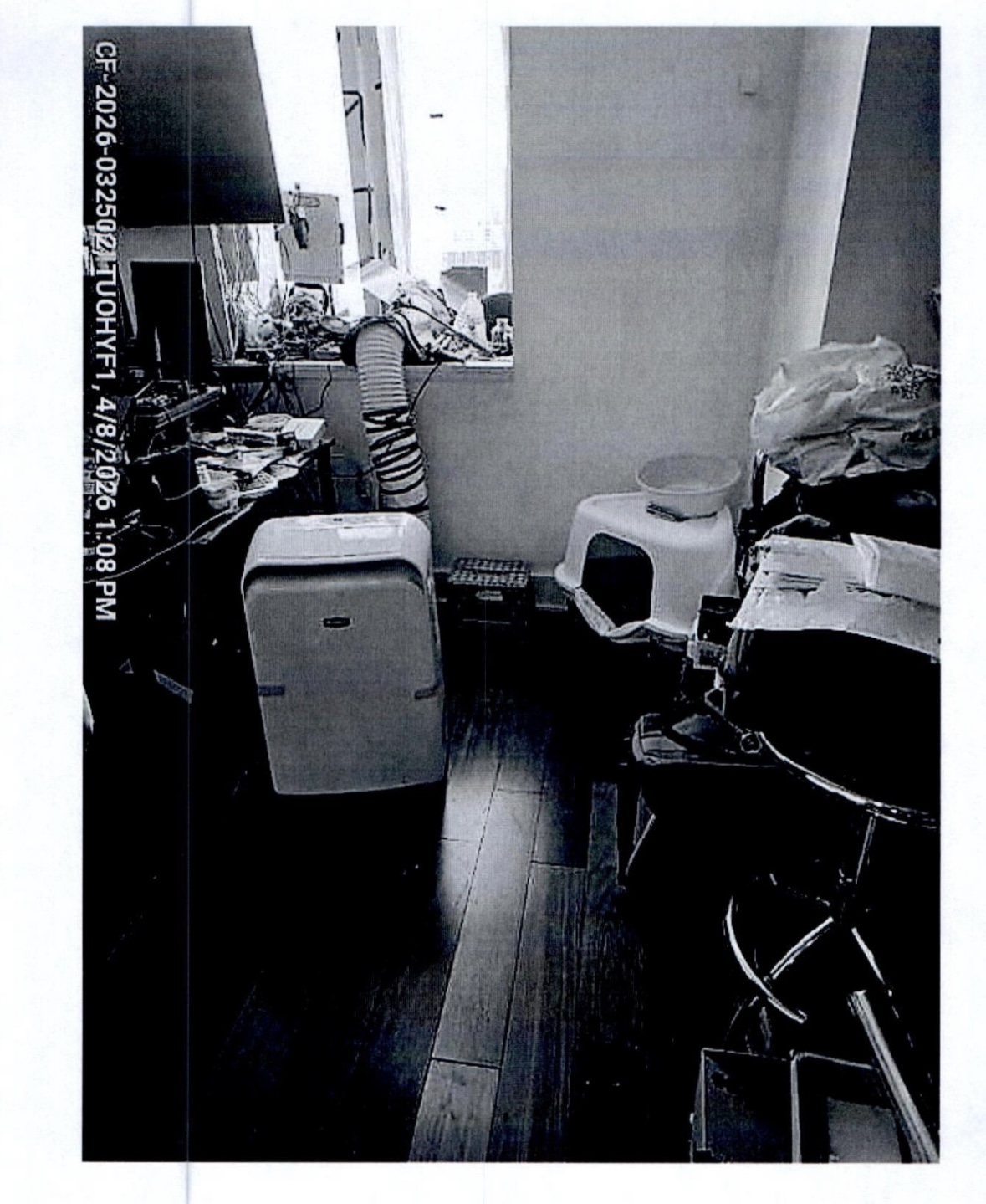
No one made him take it. The portable unit was not even running when he arrived — there was no active cooling or venting to capture in that moment — and he photographed it anyway. On a no-heat call he deliberately pointed his camera at an idle portable AC unit and its foil-taped exhaust hose, because that was the thing in the room. You do not photograph a portable AC to prove the heat works. He documented the unit and its taped exhaust, then issued no violation on it.
So put his own evidence side by side. He falsified the temperature to make the no-heat complaint disappear, and he photographed the taped portable exhaust. Given that record, the hazard was never unnameable and it was never "storage." The hazard is the thing in his photo — a foil-taped portable AC exhaust, over 100°F, venting into a sealed apartment with no working heat. There is no other record, and no other photo, suggesting anything else. He was not photographing the window; the window is behind it. And when a "fire hazard" is invoked days later, it runs straight into this: the one thing he actually documented was the taped, overheating exhaust.
He cannot say he did not notice it. He photographed it. Noticing is not in question. What remains is that he saw it, recorded a false temperature, and closed the file.
Follow that photo forward. He saw something worth documenting — the photo proves it. The thing he documented is what made me sick: it put me in an ambulance on May 6. Then the City's own supervisor, Anthony Williams, made me re-enter that unit on June 10 — back into the hazard his own inspector had already photographed, through a respirator, a third exposure. And when I said I would report how this was handled, Williams's reply was that reporting him is a threat. A photographed hazard, an induced illness, a forced re-entry into it, and then my complaint recast as the offense.
5. Anthony Williams, L&I Code Enforcement Supervisor
Anthony X. Williams is the Quality of Life Code Enforcement Supervisor for L&I's North District. He is Tuohy's supervisor. Every email below had the Office of the Inspector General copied, and from April 24 on, Councilmember Squilla.
| Date | What happened |
|---|---|
| Apr 13, 2:45 PM | I email Williams with a report on the inspection, the 16 open violations at the building, and building staff's statement to me that the building would never be condemned because of its relationship with the City. |
| Apr 13, 4:04 PM | Williams replies that he researched the property; the inspector "did address the complaint for no-heat in the unit with no violations being found"; ventilation goes to Inspection Safety & Compliance; "The parcel has no open complaints." I reply at 4:19 PM about how the reading was taken. |
| Apr 14, 10:25 AM | Williams: all complaints have been addressed, "please feel free to put in another complaint." He does not address the reading. He never does. |
| Apr 24 | Williams confirms in writing there is no fire violation on record and explains the storage question (above). |
| Jun 8 | Rep. Waxman's office forwards my chemical-exposure complaint to the City side with the note: "This seems like a city issue." |
| Jun 10, ~10:34 AM | Williams and a second inspector arrive at Unit 806, brought in through Squilla's office. I am down the street. On my Ring camera I tell them I can't be in there because of the chemicals. Williams agrees to wait 20 minutes. |
| Jun 10, ~10:55 AM | Williams will not enter unless I enter with him. In his later words: "I only stated that I and the other inspector would not go inside unless you were able to show us where the alleged violations were." My doctor had advised me in writing on May 21 not to re-enter. I put on a respirator and went in. I was re-exposed. My physician's June 11 letter is about that day. |
| Jun 10 | On site, Williams acknowledges no City agency is equipped to inspect chemical contamination of this kind and says he will find out who can. |
| Jun 16 | I email Williams with remediation and testing questions. No response. |
| Jul 7, 9:59 AM | Williams emails, with Squilla in the To line and two L&I managers copied, asks me to "stop personally emailing" him and says he "will not be subjected to threats." On the forced entry he writes, in one sentence: "At no time did I force you to go inside, I only stated that I and the other inspector would not go inside unless you were able to show us where the alleged violations were." He then states the unit "was both disconnected and the tape had been removed" — so by his own account there was no active condition left to show. He confirms Code Enforcement "doesn't govern" the chemical exposure and that his inquiry produced "no direction to give me, as to whom might address this type of complaint." He says the HVAC case is "in court status" and it "might be more beneficial to reach out to management" for accommodation. The management he sends me back to is the respondent in my open Fair Housing Commission complaint. |
One more thing Williams never mentioned, after writing that he had researched the property: Post Goldtex LP's rental license (No. 602204) had expired on February 28, 2026. Through April, May and June, while the City corresponded with me about this building, the landlord was collecting my rent and issuing me a non-renewal and a Notice to Quit without a license. The license and the violation history live in the same City file. Neither the inspector nor Williams disclosed it in any contact with me.
During this same period L&I cited the building twice as an Unfit Structure (CF-2026-012614, CF-2026-012633) and put its HVAC case into court.
The entry he said he didn't compel
Williams's own July 7 email defeats itself three times over. He wrote: "At no time did I force you to go inside, I only stated that I and the other inspector would not go inside unless you were able to show us where the alleged violations were." Those two clauses describe one thing: my physical re-entry was the condition he placed on the inspection proceeding. That is compulsion, stated in the same sentence as its denial.
And it was unnecessary on every ground, by his own record:
- By law. An occupant's consent to entry can be given at the door. I was present at the threshold, in a respirator, available to direct the inspectors. No provision of L&I authority requires a tenant to physically re-enter alongside the inspector.
- By the photographs. Williams's stated reason was that he needed me inside to "show" him where the violation was. But the hazard was already in his own inspector's timestamped photos — the taped portable exhaust, pictured above, stamped April 8. It was located and framed two months before he made me re-enter to "show" it. There was nothing left for me to point out.
- By his own words. He wrote that the unit "was both disconnected and the tape had been removed." By his own account the source was already gone — so there was no active condition inside to observe at all. As I put it back to him: if the source had already been removed, my re-entry was not necessary to observe any active condition.
I had written medical advice, dated May 21, not to re-enter. I went in only because the inspection would not otherwise proceed, and I was re-exposed — my third documented acute chemical exposure, through a respirator. My physician's June 11 letter is about that day.
The "threat," and who he copied
Williams's answer to my saying I would file a complaint about his handling was to write that he "will not be subjected to threats" and to ask me to stop personally emailing him. Stating an intent to seek review through the proper channels is not a threat. In the same message in which he told me to cease contact, he expanded the recipients to include two officials in his own department: Rasheedah Parlin, an L&I Code Inspections Manager who previously held Williams's own Code Enforcement Supervisor title before advancing above it, and Elizabeth Carrasquillo, who held that same title through 2024 — each positioned to judge whether his account of his authority at the inspection was accurate.
6. Councilmember Mark Squilla, Vice Chair, Council Committee on L&I
Mark Squilla has represented the 1st Council District, which includes this building, since January 2, 2012. He is Vice Chair of Council's Committee on Licenses and Inspections. Before Council he spent 25 years as a systems analyst at the Pennsylvania Auditor General's Office and holds a computer science degree. He has been quoted: "There's nothing like being able to call a commissioner at L&I… it makes life a lot easier."
Who owns the building, and what Squilla knew
The owner of record is Post Goldtex LP, controlled by Michael Pestronk of Post Brothers. My rent posts to Post Goldtex. Goldtex was the biggest development fight in Philadelphia in 2012, Squilla's first year in office, between Post Brothers and the building trades unions. During that fight L&I shut down the Goldtex site over licensing, and Pestronk publicly called it spot enforcement driven by political pressure.
City campaign-finance records show Michael Pestronk gave Squilla for Council $2,000 on October 20, 2021. Post Brothers executive Joshua Guelbart gave $3,100 on November 1, 2023 and $1,000 on March 14, 2025. Total: $6,100.
April 24: on the record that nobody could name the hazard
"Justin, Happy to work with You and Goldtex staff to address this concern. We did ask L&I to address and would love to know what the fire hazard is that is being reported. Sincerely, Mark"Reply-All, April 24, 2026, with Greystar on the thread
August 19: the meeting
Squilla's office set up a meeting with me on August 19. Colleen McAllister, Chief of Staff to State Rep. Mary Isaacson, was in the room. It was not recorded. What follows is my account.
The meeting was about me, not about remediation or the data problem I had raised. Squilla already knew about jlegal.pro and about my fair housing complaint before I brought up either. When I raised the building's code enforcement history, he said losing the certificate of occupancy would force all the residents to move out and "we don't want to do that to people." On the chemical exposure, he said it's a private building so the City can't act, and suggested I have a friend go into the unit to get my belongings. He urged me to use my lawyer to settle with Goldtex that week and said he believed Goldtex wanted to settle. He framed settling repeatedly as better for my mental health, so I wouldn't have to worry about lawsuits over what's on jlegal.pro. He said he knows the Post Brothers personally and offered to call "Mike," the owner, for me. He said he didn't know Greystar wasn't the owner, then corrected himself: "oh wait, that's right, they did a business deal."
Earlier, on the rental-license data gap I had reported, his written reply had been: "I will share with L&I to look into this possibility."
October 7 and 8: the written record
On October 7 I emailed Squilla a recap of the meeting: the relationship with "Mike," the certificate-of-occupancy comment, "phone a friend," the private-building claim, and the Greystar remark. Within a day he wrote four replies:
| Oct 8 | Squilla, in his own words |
|---|---|
| 9:14 AM | "not sure who Mike Goldtex is and do not have a personal relationship with him" |
| 9:47 AM | "I said I could reach out to the owner for you but that doesn't mean I have a personal relationship" |
| 1:08 PM | "I thought Mike Pastrock was the owner of property but may have sold it. I am not sure who the owner is" |
| 6:23 PM | "What was untrue was the the Mike was a personal friend" [sic] |
He named the owner, misspelled, in the third reply, after saying in the first that he didn't know who "Mike" was. The owner and a Post Brothers executive are his campaign donors. He is the vice chair of the committee that oversees L&I. L&I has cited this building as an Unfit Structure and I cannot live in my unit. The concern he voiced to me was the owner keeping its certificate of occupancy.
7. What ties it together
Two inspectors, one pattern
Tuohy and Williams run in parallel, and their patterns match. Tuohy photographed the hose and said nothing. Williams reviewed the file with those photos in it and said nothing. Tuohy closed a complaint his own duct reading contradicts. Williams backed the closure without addressing the reading. Both looked at the same evidence, and both wrote the opposite of what it showed.
But Williams goes further, in three ways.
First, the re-entry. Tuohy's failure was passive — he didn't act on what was in front of him. Williams actively made me walk back into the contaminated unit. His own July 7 email tries to deny it and describes it in the same sentence. And by his own words, the tape had already been removed and the unit disconnected — so there was nothing left inside to show him. He made me re-enter a unit my doctor told me to stay out of, to observe a condition he then said was already gone. That is not an oversight. That is a supervisor putting the exposure back on the tenant.
Second, the "threat." I told him I would file a complaint about his handling. He called that a threat and told me to stop emailing him. In the same email where he told me to stop contacting him, he expanded the recipients to include Parlin and Carrasquillo — people positioned to evaluate his conduct. He was building his own cover while telling me to go away.
Third, the rental license. He wrote that he "researched the property." The license and the violation history are in the same City file. Post Goldtex's license had been expired since February 28. He never mentioned it. Neither did Tuohy. The landlord was collecting my rent, issuing a non-renewal, and serving a Notice to Quit — all without a license — while the City was corresponding with me about the building.
Tuohy missed the hazard, or ignored it. Williams reviewed Tuohy's work, kept the same silence, then made me go back in.
There was a hazard in that room on April 8. It was a portable AC exhaust taped together with foil tape, running over 100°F, in a sealed apartment, venting its own fumes back into my air. It is in the inspector's photo. I showed him the thermal images of it. Greystar installed it.
If the hazard being discussed that day was the taped exhaust hose, every piece of this falls into place:
- Why "fire hazard" came up the same day an inspector was in front of a 113-degree joint.
- Why he told me in the elevator there could be one, but not what it was.
- Why staff were told not to tell me.
- Why "storage" is the version that reached L&I: the only version where the hazard is my fault instead of theirs.
- Why Greystar was demanding the portable unit back on April 14, the same day it was offering an identical one to a prospective tenant.
- Why, when the City's own supervisor finally came to look at what that unit did to the air, he made my re-entry the condition of the inspection — then denied compelling it in the same sentence, while his own email admitted the tape was already removed and the unit disconnected, so there was nothing left to "show."
- Why the councilmember who oversees L&I, a donor's building in his district, told the tenant who can't live in his unit that the concern was the owner's certificate of occupancy.
I have his photos. I have my photos. I have the sensor log. I have the texts. I have Williams' emails. I have Squilla's emails. I have the City's own words.
Exhibit A: eCLIPSE complaint history, CM-2026-031537
City of Philadelphia, database phlprod, History Report as of Nov 6, 2026 12:11:40. Three pages, as produced.
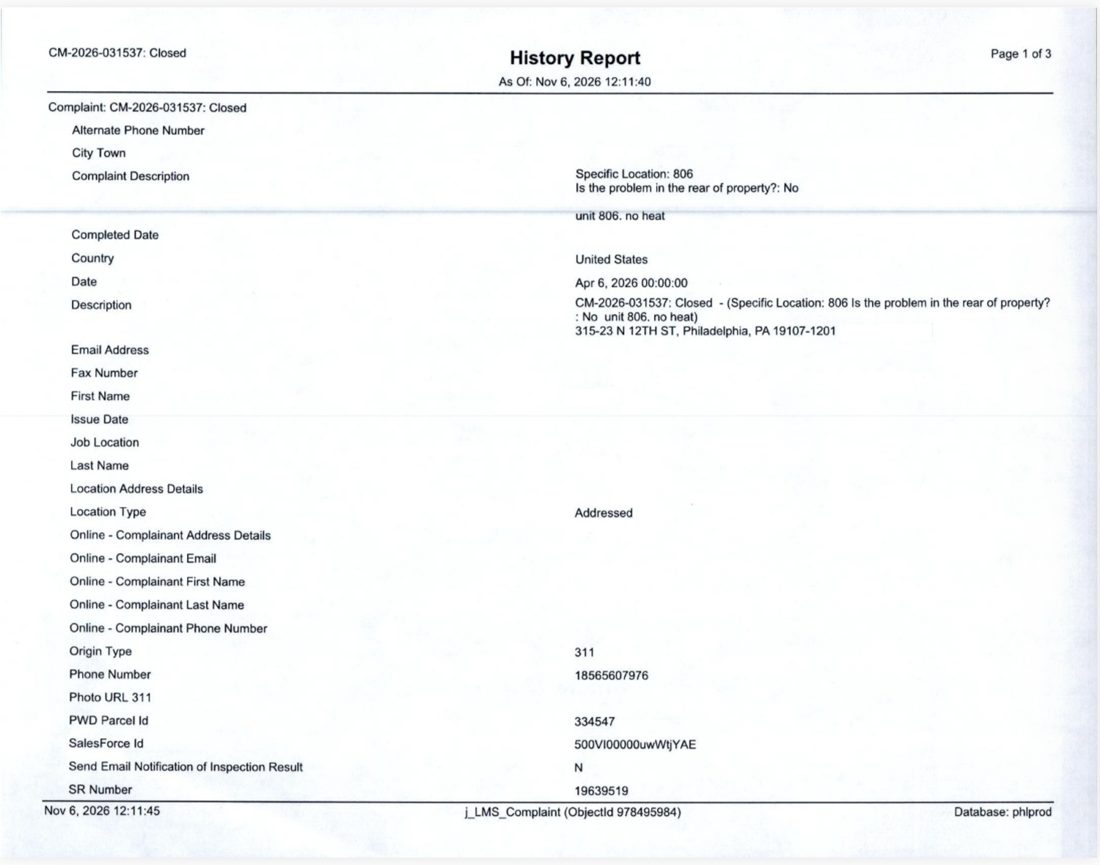
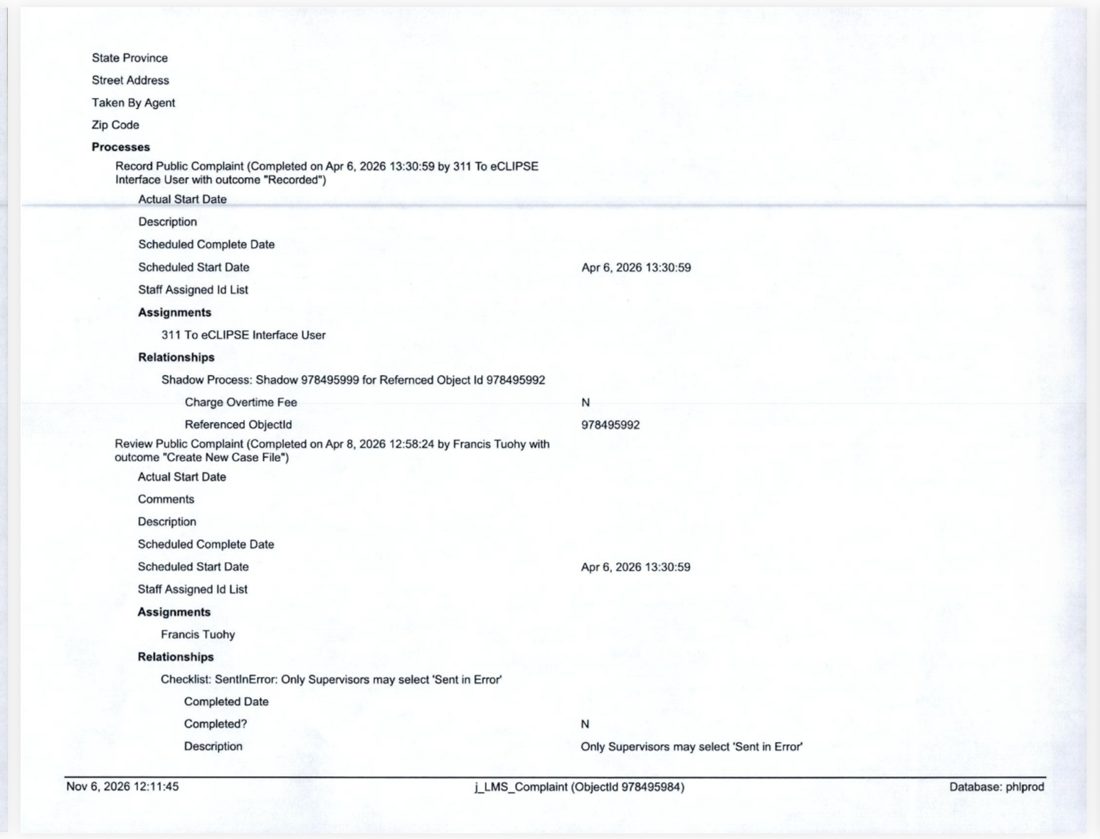
Sources. eCLIPSE LMS Complaint ObjectId 978495984 (CM-2026-031537) and case file CF-2026-032502 with inspector photos, produced under the Pennsylvania Right-to-Know Law, Nov 6, 2026. FLIR images, April 6, 2026, 2:50 PM. Temperature/humidity sensor log, combined hourly record Dec 31, 2025 – Nov 11, 2026 (7,552 readings, no gaps). Emails: A. Williams (Apr 13, 14, 24; Jul 7, 2026), M. Squilla (Apr 24; Oct 8, 2026), N. Cordial (Apr 15, 2026). Philadelphia campaign-finance data (phl.carto.com). Philadelphia Inquirer, May 3, 2012; Philadelphia Magazine. Physician letters dated Apr 10, May 21 and Jun 11, 2026. Philadelphia Police reports DC #2609047257, #26-09-47920, #26-09-055021. See also L&I Accountability. Download this page as a PDF.